

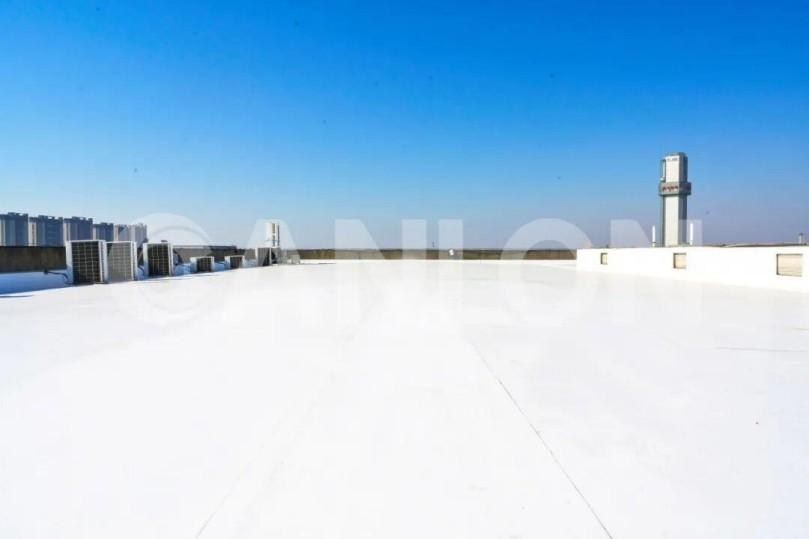
On a scorching summer day, have you ever felt that city centers are hotter than suburbs? It's not an illusion. Meteorological data shows that urban core temperatures are often 3-5°C higher than surrounding suburbs—this is the well-known "urban heat island effect." One of the key culprits behind this phenomenon is the dark roofs above our heads. Traditional asphalt roofs and black waterproofing membranes can reach surface temperatures of 70-80°C under intense sunlight. Like giant "heat-absorbing panels," they convert solar radiation into heat, continuously baking the city above. The emergence of white TPO cool roofs is changing this situation—it's like applying an "ice pack" to buildings, not only cooling the building itself but also quietly mitigating the heat of the entire city.
In waterproofing applications such as roofs, basements, and municipal engineering projects, polymer waterproof membranes are undoubtedly the mainstream choice today, with TPO and PVC being the two core materials. However, many homeowners, renovation professionals, and even newcomers to the industry easily confuse the two – both are polymer membranes, both can be hot-air welded, and both are high-performance roofing materials, but their actual materials, lifespans, and applicable scenarios are quite different! Today, Canlon will use simple, popular science language to clarify the essential differences between the two types of roll-on sheets, and provide practical selection advice for different usage scenarios.

Recently, Canlon PVC-18P polyvinyl chloride waterproof membrane and Canlon TPO-18P thermoplastic polyolefin waterproof membrane, both products of Jiangsu Canlon Building Materials Co., Ltd., have passed the authoritative testing of China Building Materials Testing & Certification Group Suzhou Co., Ltd. They have all met the requirements of GB8624-2025 "Classification of Burning Performance of Building Materials and Products" for roofing covering materials and products, specifically Class B1 (flame-retardant) burning performance, successfully obtaining national-level testing and certification. This demonstrates their robust fire-resistant capabilities in fulfilling the Ministry of Housing and Urban-Rural Development's "Good House" construction guidelines.

Bengbu City in Anhui Province is a national comprehensive transportation hub, an industrial transfer and agglomeration area in northern Anhui, and a green agricultural product production, processing and supply base in the Yangtze River Delta. The famous Bengbu Port is the largest port on the Huai River. In recent years, driven by the "dual carbon" strategy, Bengbu Economic Development Zone is striving to build a new cluster area that undertakes industrial transfers from Shanghai, Jiangsu and Zhejiang, focusing on leading industries such as equipment manufacturing, new energy and new materials and modern logistics. This brings us to our protagonist today - Bengbu Lingang Assembly and Manufacturing Industrial Park.
Against the backdrop of global climate change and increasing resource scarcity, "sustainable development" and "circular economy" have evolved from marginal concepts into core action frameworks across all industries. The construction industry, as a major carbon emitter, faces an urgent need for green transformation. Within this wave of transition, waterproofing materials are undergoing a profound green revolution—shifting from single-function products to full-lifecycle environmental value. Polymer waterproofing membranes represented by TPO and PVC, with their green attributes of recyclability, energy savings, and low VOC emissions, are becoming the technical foundation for low-carbon buildings and green certifications.

In the field of building waterproofing, a profound conceptual transformation is reshaping the design and construction logic of roofing systems. Traditional "built-up roofing" adopts a "heavy" approach of stacking multiple layers of asphalt and felt, attempting to achieve waterproofing through material accumulation. In contrast, the "single-ply roofing system," represented by TPO and PVC membranes, achieves a fundamental shift from "quantity" to "quality" and from "layering" to "integration" with its lightweight yet multifunctional single-layer membrane. Single-ply roofing refers to a roofing system that uses a single layer of flexible waterproofing membrane as the primary waterproofing component, working in conjunction with insulation layers, vapor retarders, and other components. Introduced to China in 1999, after more than two decades of development, it has become widely adopted in industrial plants, stadiums, airports, large commercial buildings, and other venues, emerging as a mai

Recently, a meeting was successfully held in Suzhou to revise three national standards: "Thermoplastic Polyolefin (TPO) Waterproof Membrane," "Polyvinyl Chloride (PVC) Waterproof Membrane," and "Chlorinated Polyethylene Waterproof Membrane," which are under the jurisdiction of the National Technical Committee on Standardization of Lightweight and Decorative Building Materials (SAC/TC 195) and the Subcommittee on Waterproofing Materials for Buildings (TC195/SC1), and to organize the revision of the industry standard "Waterborne Polymer Modified Bitumen Waterproof Coating."

In the history of modern construction, persistent leakage, akin to a "water curtain cave," has long plagued the industry and end-users. The limitations of traditional waterproofing materials in terms of durability, environmental friendliness, and construction convenience have struggled to meet the higher demands of contemporary buildings for long-term safety, energy efficiency, and sustainability. Today, polymer waterproofing membranes, represented by PVC (Polyvinyl Chloride), TPO (Thermoplastic Polyolefin), and HDPE (High-Density Polyethylene), are leading a technological revolution with their superior performance, becoming the preferred solution for large public buildings, industrial plants, transportation hubs, and green roofs.

Polymer waterproofing membranes play a critical role in modern construction, with Thermoplastic Polyolefins (TPO) and Polyvinyl Chloride (PVC) being two widely used primary materials. Their long-term performance, particularly weatherability and durability, directly determines the reliability and service life of building envelopes. This article will delve into the impact of environmental factors on the molecular structures of these two materials from a materials science perspective and explore the underlying aging mechanisms and their respective application scenarios.