
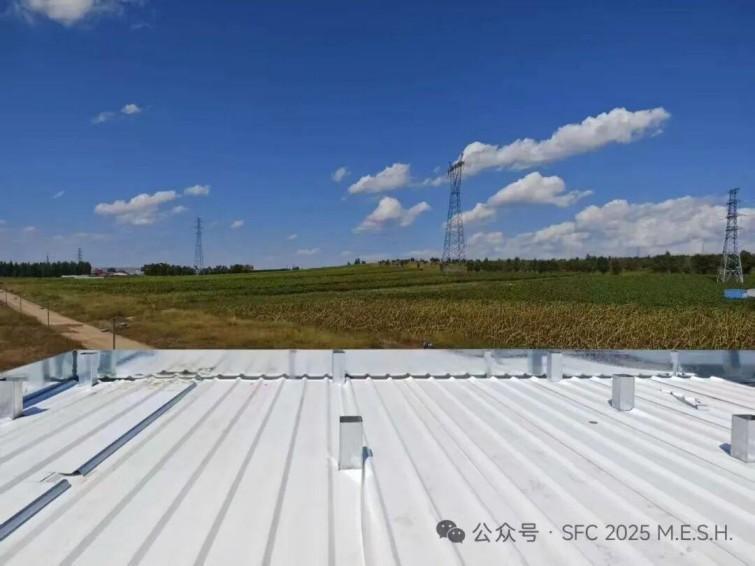
On the path of exploring green building and sustainable development, universities are pioneers of innovation, while the support of industry provides a solid foundation for the implementation of these innovations. The Sustainable Future Challenge ( SFC ) is a global team competition for universities worldwide, aiming to respond to the United Nations Sustainable Development Goals and China's "dual-carbon" strategy. It is an upgraded version of the International Solar Decathlon (SDC), which is known as the "Olympics" of the solar energy industry.

The National Building Standard Design Atlas 25J950, "Building Waterproofing," is an important guide for professionals in the building waterproofing industry. It provides detailed descriptions of waterproofing projects for metal roof panels and polymer membrane metal composite profiled sheet roofs, offering a unified and scientific technical reference for the Chinese building waterproofing industry. In the compilation of this national standard atlas, Canlon not only contributed its waterproofing expertise as a participating unit, but the technical standards for its representative innovative product—the polymer membrane metal composite profiled sheet system—were also included in Chapter 10. Let's take a look at the relevant content.
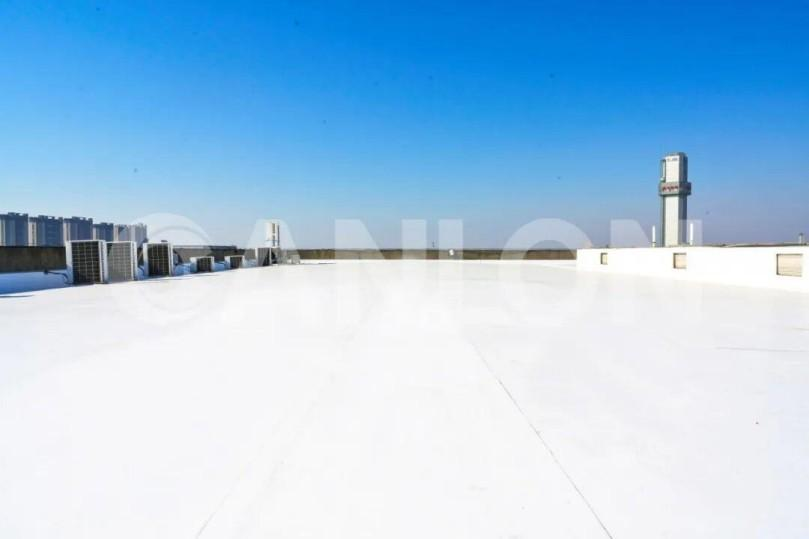
The roof is the part of the building envelope most directly affected by the external environment. The design of its waterproofing and insulation system directly determines the building's durability and energy efficiency. Based on the relative positions of the waterproofing layer and the insulation layer, flat roof projects can be divided into three basic types: upright, inverted, and sandwich. Understanding the principles and applicable conditions of these three structural systems is fundamental to roof project design.

Canlon is a functional building materials manufacturer integrating R&D, manufacturing, sales, and construction services of waterproofing materials. Established in 2011 and listed on the A-share market in 2017, the company has been deeply involved in the field of polymer new materials for many years. Closely following the development needs of key industries during the "15th Five-Year Plan" period, it provides diversified and customized system solutions for the roofing needs of various industrial and commercial buildings.

In the development history of building waterproofing materials, Polyvinyl Chloride (PVC) membranes have undergone a technical transformation from "widely questioned" to "mature and reliable." The embrittlement and cracking issues caused by plasticizer migration in early products once cast a shadow over this material. However, after decades of formulation optimization and technological iteration, modern PVC membranes have become an indispensable choice in underground engineering, tunnel and bridge projects, and roofing waterproofing, thanks to their cost-effectiveness and full-scenario applicability. This article traces the evolutionary path of PVC membranes, analyzes the technical logic behind their green upgrade, and highlights the innovative practices of industry benchmark enterprises.

In high-end industrial sectors such as new energy, precision manufacturing, and biopharmaceuticals, buildings are no longer mere shelters from wind and rain. A lithium battery plant workshop must strictly maintain temperatures below 25°C and humidity below 30%; otherwise, battery performance and yield rates are directly affected. If air quality fluctuates in a semiconductor cleanroom, the entire production line may face shutdown. In such scenarios, the roofing system is no longer just a waterproofing layer, but a "Super Shield" that safeguards production safety, product quality, and operational efficiency. Polymer waterproofing membranes represented by TPO, with their comprehensive properties of weatherability, energy-saving high reflectivity, chemical corrosion resistance, and wind uplift resistance, are becoming the preferred choice for high-end industrial plant roofing projects.

Remember when Super Typhoon Yagi made landfall in Wenchang, Hainan and Xuwen, Guangdong with winds exceeding Category 17? Many traditional metal roofs along the coast were torn off, corroded, and leaked, posing a severe challenge to transportation hubs. At that time, Canlon TMP® Integrated Roofing Panels proved their strength. With its top-notch wind uplift resistance and long-lasting corrosion resistance, TMP integrated panels withstood wind damage during the roof renovation projects of five major stations on the Guangdong-Hainan Railway: Wanning Hele Station, Xuwen Station, Beigang Station, Wenchang Station, and Haikou East Station. The practical results proved the benchmark solution of "no roof lifting, no corrosion, and no leakage"!

Recently, the Yanjing Beer (Danjiangkou) production base project, whose roof system construction was undertaken by Canlon, has entered the final sprint stage and is scheduled to be officially put into operation in July this year. As a key project of the Beijing-Yanjiangkou counterpart cooperation and a key industrial project of Hubei Province, the Yanjing Beer (Danjiangkou) production base is expected to have an annual output value of over 2 billion yuan. It will become one of the largest and most intelligent modern beer production bases in Central China, and will also become one of the classic representative cases of Canlon's PMP® integrated panels.

Bengbu City in Anhui Province is a national comprehensive transportation hub, an industrial transfer and agglomeration area in northern Anhui, and a green agricultural product production, processing and supply base in the Yangtze River Delta. The famous Bengbu Port is the largest port on the Huai River. In recent years, driven by the "dual carbon" strategy, Bengbu Economic Development Zone is striving to build a new cluster area that undertakes industrial transfers from Shanghai, Jiangsu and Zhejiang, focusing on leading industries such as equipment manufacturing, new energy and new materials and modern logistics. This brings us to our protagonist today - Bengbu Lingang Assembly and Manufacturing Industrial Park.