
Views: 26 Author: Site Editor Publish Time: 2026-07-28 Origin: Site


Major Heat arrived recently, marking the hottest time of the year. Walking on asphalt roads makes your feet burn, and opening a car door brings a wave of heat—our building rooftops are naturally enduring an even more brutal "baking" test than the ground.
Have you ever thought that giving your roof a layer of "sunscreen and cooling" skin is actually an easy way to relieve the sweltering heat?

Why does the roof need to be "cooled down"?
Under direct sunlight in summer, the surface temperature of roofs can often soar to over 70°C. This heat continuously flows into the interior through the roof—air conditioners work frantically to cool the rooms, electricity bills skyrocket, and the urban heat island effect intensifies.
Worse still, high temperatures accelerate the aging and embrittlement of roofing materials—including rolls and their plasticizers—leading to surface peeling and failure of waterproofing performance. A "feverish" roof not only has a significantly reduced lifespan, but also increases the risk of accidental ignition.
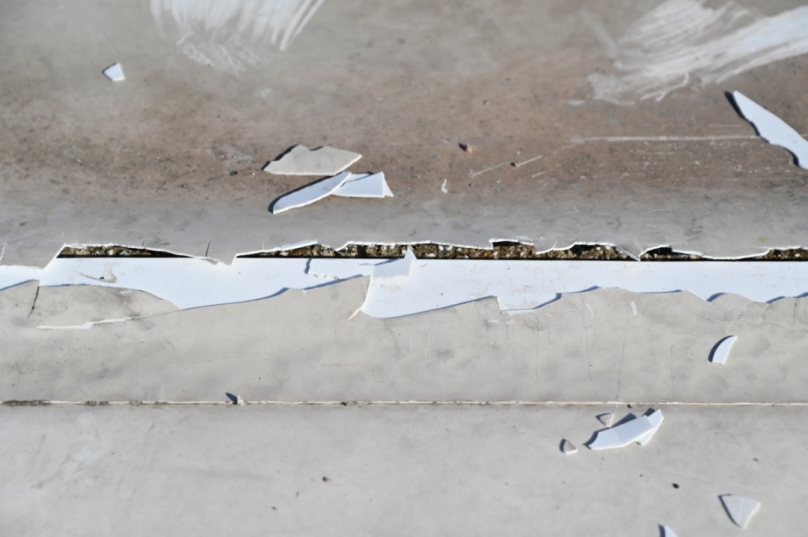
In environments with extremely stringent temperature control requirements, such as data centers, lithium battery factories, and chip manufacturing plants, every 1°C increase in roof temperature adds to cooling costs and increases the risk of equipment failure. Therefore, cooling the roof is highly beneficial!
Give buildings a "light-colored sun-protective coat"
The principle behind cool roofs is actually quite simple—high reflectivity + rapid heat dissipation. You can think of it like wearing light-colored clothes in summer: dark clothes absorb heat, while light-colored clothes reflect light. Cool roofs use light-colored waterproof membranes or high-reflectivity coatings to reflect most of the solar radiation directly back into the atmosphere, instead of letting the roof absorb it all. At the same time, it can quickly release the heat that has already been absorbed.
Research from Lawrence Berkeley National Laboratory in the United States shows that by reducing one aspect and increasing another, the surface temperature of the roof can be significantly reduced, and the air conditioning load drops sharply. This alone can save a considerable amount of cooling energy for the building.
In addition, cool roofs can alleviate the urban heat island effect, extend the lifespan of roofs, and reduce carbon emissions—truly killing two birds with one stone.
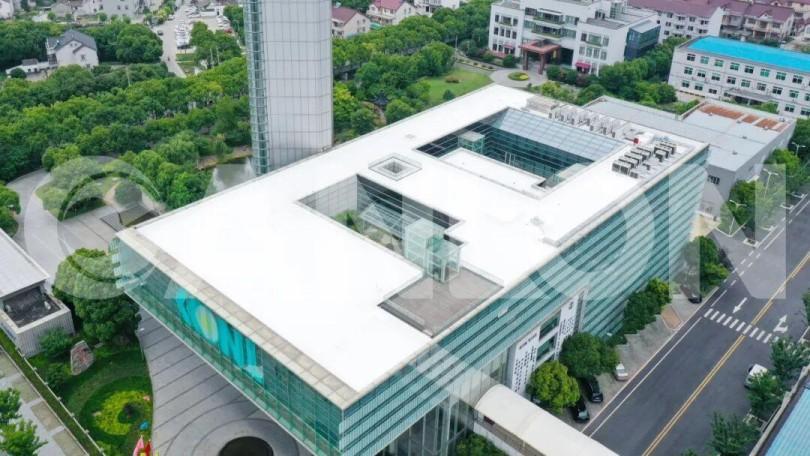
Canlon continues to advance cold roofing technology.
In the field of cold roofing, Canlon has always been at the forefront of innovation. As early as 2018, Canlon established a dedicated team to study cold roofing technology. After three years of outdoor testing, its TPO/PVC polymer waterproof membrane successfully passed the product rating approval of the Cool Roofing Rating Committee (CRRC) in the United States, becoming one of the few companies in China to hold certifications for both polymer waterproof materials.
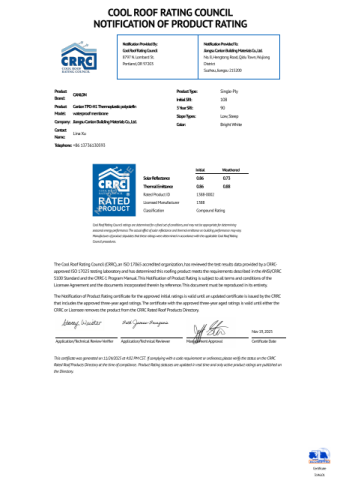
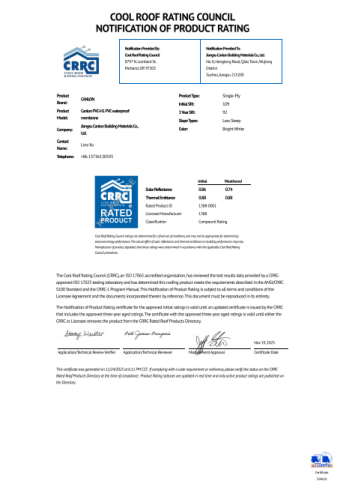
CRRC certification precisely calculates two core indicators: solar reflectivity and thermal emissivity—these two indicators directly determine the roof's energy efficiency. Canlon's products not only meet international standards but also simultaneously help building projects obtain scores for both the US LEED green building certification and the EU CE certification.
In addition, dust is a major enemy affecting the heat reflection efficiency of white cold roofs. Statistics show that if more than 2 grams of dust are present per unit area of the roofing membrane, its heat reflection efficiency will decrease by 50%. In response, Canlon has developed an innovative project for a self-cleaning coating on single-ply waterproof roofing membranes, aiming to achieve properties such as aging resistance, stain resistance, and easy cleaning of surface stains by rainwater, effectively reducing dust adhesion. This project won the "Excellent Technology Demand Award" at the Yangtze River Delta International Innovation Challenge.

In summary, Canlon's single-ply roofing system integrates waterproofing, insulation, energy saving, and sound insulation. The light-colored surface has a high solar reflectivity, making it a multi-functional cool roofing solution that solves everything in one installation.
In addition to Canlon's proud polymer waterproof membrane, Canlon has also improved the traditional modified bitumen waterproof membrane by using a specific reflective polyolefin elastomer layer as the face film. The reflective fillers include visible light reflective fillers and near-infrared light reflective fillers, which not only have good adhesion to the bitumen adhesive layer, but also have high solar reflectivity and high hemispherical emissivity, which is beneficial to the energy-saving insulation of building roofs and has obtained relevant patent certifications.
During the sweltering heat of summer, instead of running the air conditioner at full capacity 24 hours a day, why not start from the roof and let Canlon bring a "cooling revolution" to buildings.
