
Views: 21 Author: Site Editor Publish Time: 2026-07-21 Origin: Site


Currently, many homeowners are experiencing problems with dampness, efflorescence, mold, and damp walls and floors in their basements. Even after repeated grouting, painting, and application of roofing materials, these issues persist. The core reason is that continuous "passive water blocking" can only address surface water and cannot solve the problem of gaseous water and capillary water that continuously seep into the pores of the concrete.
Electro-osmosis moisture-proofing (electro-osmosis solution) is currently the mainstream and mature technology in the renovation industry for addressing persistent dampness in basements. Unlike traditional sealing methods, it provides a long-term solution to dampness problems at the structural level. Today, Karen Renovation will break down its principles in layman's terms, clearly explaining its applicable scenarios, practical effects, and advantages and disadvantages—

Principle: Active water diversion, rather than passive water blocking.
Like most building exteriors, the interior of a basement concrete structure is filled with tiny pores, like countless miniature straws, which continuously draw moisture from the underground soil into the room, resulting in perpetual dampness.
The water molecules we encounter daily are polar molecules composed of one oxygen atom and two hydrogen atoms. When the electroosmosis system is working, the low-voltage pulsed electric field generated further enhances the polarity of the water molecules. Utilizing the physical principle of "like charges repel, unlike charges attract," the system continuously pulls positively charged water molecules that would otherwise seep into the room towards the negative pole on the outside of the structure. When the system detects low humidity inside the building structure, it automatically adjusts its operating state to maintain the directional repulsive effect of the electric field, fundamentally blocking the reverse penetration of water molecules and achieving long-term moisture-proofing.
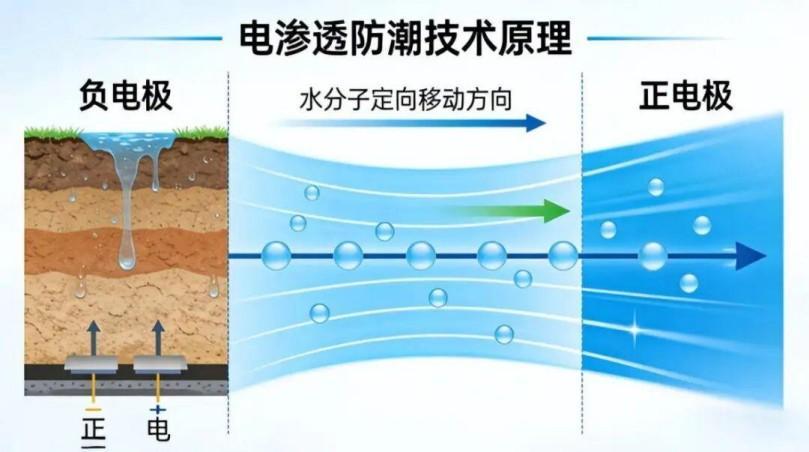
The core logic of the electroosmosis solution is a low-voltage electric field and directional water guidance: a positive electrode network is laid inside the basement structure, and a negative electrode is buried in the outdoor soil. Through a safe low-voltage pulsed electric field, the principle of water molecule polarity is used to push and guide the water that would have seeped into the room back to the outdoor soil, thus blocking capillary water infiltration at its source. As long as the system continues to operate, water molecules will continue to move outwards and will not flow back into the room.
Typically, electroosmosis systems use safe, low-voltage methods, with radiation levels far lower than those from mobile phones and home appliances. They pose no risk to humans or household equipment and are supported by the national industry standard JC/T60015-2022, ensuring technological compliance and maturity. The system features intelligent start-stop; it drains water at full capacity when humidity is high and enters low-power standby mode once humidity levels are within acceptable limits, achieving automatic moisture protection around the clock.
Main use cases
Electro-osmosis is not a panacea, but it is highly adaptable to situations where traditional waterproofing fails. Its core applicable scenarios are as follows:
1. Basement mainly characterized by capillary dampness: There is no obvious water leakage, but the ground is covered with condensation, the walls are moldy, the air is humid, and there is a musty smell. This is the most common condition in residential basements.
2. Failure of repeated waterproofing repairs: Repeated grouting, leak repair, waterproofing application, and damp-proofing layer construction still result in dampness during the plum rain season and flood season. This is a typical case of passive waterproofing failure, and electro-osmotic active moisture-proofing technology is suitable.
3. Projects where external wall excavation is not possible: If there is greenery, paved ground, pipelines, or adjacent buildings on the outside of the basement, and it is not possible to excavate and redo the waterproofing on the water-facing side, the work can be carried out on the indoor back side, causing minimal damage to the original decoration and structure.
4. Functional basements that require long-term dryness: These are planned as home theaters, storage rooms, wine cellars, or leisure areas, and require a stable, low-humidity environment to prevent repeated dampness and mold growth.
Main use cases
The electroosmosis solution is a gradual way to eliminate dampness. The construction does not damage the structure and does not require large-scale demolition of walls and floors. It gradually shows results after completion: the musty smell and surface dampness will obviously subside in 7-10 days, the moisture content of the structure will drop significantly in about 30 days, and the indoor humidity will stabilize in a livable range within 60 days, completely solving a chain of problems such as efflorescence on walls, mold on cabinets, and peeling paint.
Compared to traditional solutions, its core advantages are long-term stability and no need for repeated maintenance. A properly designed system can last for over 25 years, almost the same lifespan as the building structure; daily energy consumption is extremely low, less than 1 kWh per day, with no consumables and minimal maintenance. While it cannot replace waterproofing or condensation treatment, for homeowners suffering from damp walls and for whom traditional solutions have repeatedly failed, electro-osmosis is one of the most reliable solutions, allowing you to say goodbye to year-round dehumidification and repeated leak repairs.