
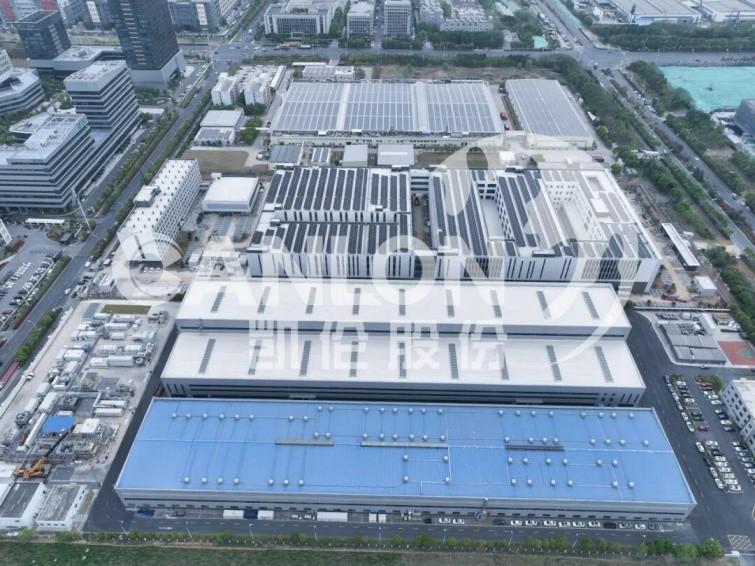
When the "15th Five-Year Plan" placed the construction of a modern industrial system at its core, and new-quality productivity was established as the core engine of industrial upgrading, its influence is being transmitted to the architectural space at an astonishing speed. According to Colliers International's projections based on the "14th Five-Year Plan" industrial economic data, during the "15th Five-Year Plan" period, the job creation resulting from the upgrading and efficiency improvement of traditional industries and the cluster development of emerging industries will generate a huge demand for approximately 470 million square meters of new office and R&D space. At the same time, architectural space is also undergoing a transformation from a single provider of physical space to a systematic ecological leap towards "professionalization, intelligence, and ecology."

In the field of underground engineering, waterproofing is a strategic endeavor about building safety, service life, and operational costs. As the part of a building in closest contact with the groundwater environment, basements endure long-term challenges from hydrostatic pressure, moisture erosion, and structural deformation. Once waterproofing fails, it can lead not only to leakage, mold, and steel reinforcement corrosion but may also endanger structural safety, with extremely high repair costs. HDPE (High-Density Polyethylene) waterproofing membranes, with their exceptional material properties and the systematic advantages of pre-applied bonding, are becoming the ideal solution for basement waterproofing.

To address common quality issues in construction projects, strengthen construction safety, and ensure safe production before the Spring Festival, the Quality Inspection Center of the Housing and Construction Bureau of Siyang County, Suqian City, Jiangsu Province, organized a waterproofing construction training and safety production publicity meeting on September 23. Heads and technical management personnel from construction, supervision, and other units involved in ongoing projects throughout the county participated in the training.

In the field of underground waterproofing, there is a persistent challenge that has plagued the industry for decades—water migration. In traditional waterproofing practices, a physical interface always exists between the waterproofing layer and the structural body. Once the waterproofing layer is locally damaged, groundwater can travel long distances along this gap, seeping into the building through weak points in the structure. More frustratingly, the leakage point is often far from the damage point, making repairs like "finding a needle in a haystack."

On a scorching summer day, have you ever felt that city centers are hotter than suburbs? It's not an illusion. Meteorological data shows that urban core temperatures are often 3-5°C higher than surrounding suburbs—this is the well-known "urban heat island effect." One of the key culprits behind this phenomenon is the dark roofs above our heads. Traditional asphalt roofs and black waterproofing membranes can reach surface temperatures of 70-80°C under intense sunlight. Like giant "heat-absorbing panels," they convert solar radiation into heat, continuously baking the city above. The emergence of white TPO cool roofs is changing this situation—it's like applying an "ice pack" to buildings, not only cooling the building itself but also quietly mitigating the heat of the entire city.

Polyurethane waterproof coatings such as "solvent-based" and "solvent-free," "water-based" and "oil-based," do you feel like you're making an uncertain choice? Behind this lies an invisible battle between environmental protection, health, and construction safety. Today, Canlon will help you clarify this crucial choice that determines the quality of your bathroom waterproofing!
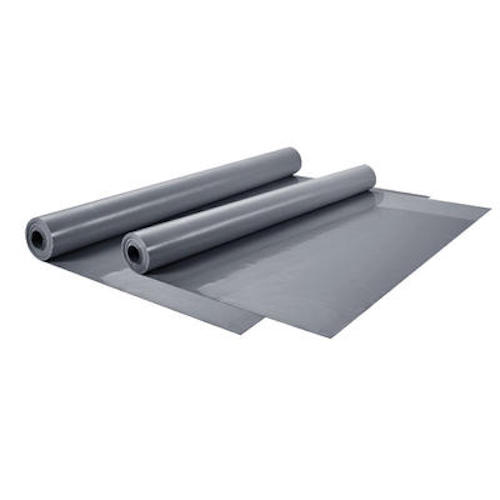
In scenarios such as rooftop gardens and planted decks over underground parking garages, the threat of plant roots penetrating the waterproofing layer is a critical engineering challenge. Many mistakenly believe that “root-resistant” membranes work by “poisoning” roots—a widespread misconception. In fact, root-resistant waterproofing membranes operate through two primary mechanisms: physical root resistance and chemical root resistance. The former relies on the material’s own “hard power” without any chemical additives; the latter uses specific agents to alter root growth behavior. These principles are fundamentally different and suit different applications.

Concrete roof waterproofing protects porous roof decks from moisture intrusion, cracking, rebar corrosion, and long-term structural damage. This guide explains how concrete roof waterproofing systems work and compares liquid-applied, sheet-based, and cementitious solutions for different project conditions. It also covers membrane flexibility, UV resistance, ponding water performance, renovation costs, curing time, substrate preparation, and quality testing. By matching waterproofing materials to climate, roof condition, traffic, and drainage requirements, facility owners and contractors can reduce leakage risks, extend roof service life, and improve long-term building protection.

Concrete roof waterproofing membranes provide a critical barrier against water intrusion, cracking, rebar corrosion, insulation damage, and premature structural deterioration. This guide explains how roof waterproofing membranes protect concrete decks and compares liquid-applied, modified bitumen, and single-ply membrane systems. It also covers crack-bridging performance, UV resistance, installation speed, lifecycle value, surface preparation, and moisture-related risks. By matching the waterproofing system to roof conditions, climate, traffic, and project requirements, building owners can reduce leaks, extend roof service life, and improve long-term asset protection.