
Views: 0 Author: Site Editor Publish Time: 2026-03-04 Origin: Site


Understanding EN Standards for TPO Roofing Membranes in Commercial Roofing is essential for any property owner or contractor aiming for a durable, energy-efficient roof. These European Norms set clear benchmarks for tensile strength, UV resistance, fire performance, and water tightness, helping you choose reliable TPO membranes. In this guide, we’ll explore how EN certification affects installation, performance, and long-term maintenance, making it easier to select, install, and care for TPO roofing systems that protect your building and investment effectively.
EN standards, short for European Norms, exist to harmonize building regulations across the EU. They make sure materials, installations, and performance meet consistent safety and quality levels. For commercial roofing, EN standards are essential—they help designers, contractors, and property owners know what works reliably for flat or low-slope roofs.
Key EN standards that matter for commercial roofing include:
| Standard | Scope | Key Requirement |
|---|---|---|
| EN 13956 | Flexible sheets for waterproofing | Tensile strength, elongation, tear resistance |
| EN 12311-2 | Determination of tensile properties | Measures durability under stress |
| EN 1928 | Watertightness test | Ensures no leaks under pressure |
| EN 13501-5 | Fire classification of roof coverings | Fire performance and reaction ratings |
These norms guide everything from material selection to installation practices. They provide measurable benchmarks so you can compare products easily and ensure a reliable roof. They also influence warranties. Many manufacturers only guarantee performance if materials and installation meet EN certification.
For TPO roofing membranes, EN 13956 is the main standard. It sets out clear criteria for testing flexibility, strength, and durability.
Important performance metrics include:
Tensile Strength: Measures how much stress the membrane can handle before tearing.
Elongation: How far it stretches without breaking—key for roof movement.
Tear Resistance: Determines puncture tolerance, especially around fixtures.
Dimensional Stability: Checks if the membrane maintains size under heat and cold.
Manufacturers test membranes in certified labs. They often label products with EN compliance marks, which signals that the material passed all essential tests. We also see EN standards influence installation. Certified TPO membranes tend to have uniform thickness, precise dimensions, and reliable seam performance. This makes it easier for contractors to achieve a waterproof, long-lasting roof. Using EN-certified TPO reduces guesswork. It ensures the roof performs under UV exposure, wind uplift, and temperature changes over time.
TPO membranes must handle mechanical stress without failing. EN standards test key mechanical properties like:
Tensile Strength & Elongation: Determines how far it stretches under load before breaking. Important for flat roofs subject to structural movement.
Tear & Puncture Resistance: Measures ability to withstand foot traffic, hail, or sharp objects.
Dimensional Stability After Thermal Cycling: Ensures the membrane maintains size and shape after repeated heat and cold cycles.
These tests ensure the material remains robust under everyday stress, reducing the chance of leaks or membrane damage.
TPO roofs face sun, rain, and pollutants. EN standards measure their resilience:
UV Exposure & Heat Aging Tests: Simulate long-term sunlight exposure to confirm no brittleness, cracking, or color loss.
Chemical Resistance: Checks durability against ozone, air pollutants, and common cleaning agents.
They help building owners choose membranes that last longer in varying weather, protecting both structure and investment.
Fire safety is critical for commercial roofs. TPO membranes are classified under EN 13501:
| EN 13501 Class | Description | Common Use |
|---|---|---|
| B Roof Coverings | Limited fire spread | Office, warehouse |
| C Roof Coverings | Moderate fire spread | Industrial buildings |
| D Roof Coverings | Basic fire resistance | Temporary or non-critical structures |
Testing includes fire propagation, reaction to external fire, and material fire ratings. Membranes passing these standards reduce fire risks while meeting regulatory requirements.
EN standards ensure TPO roofs remain watertight:
EN 1928 Watertightness Test: Measures leakage under hydrostatic pressure.
Seam Quality: Heat-welded seams provide superior durability compared to adhesives or mechanical joints.
Lifespan Impact: Poor seam integrity is a common cause of early roof failure.
A well-installed membrane with certified seams helps prevent leaks and minimizes future repair costs.
TPO membranes also contribute to energy efficiency under EN standards:
Solar Reflectance & Thermal Emissivity: High reflectivity reduces heat absorption. Thermal emissivity allows heat to escape at night.
Benefits: Lowers HVAC demand, decreases energy costs, supports green building certifications like LEED or BREEAM.
These properties make TPO membranes ideal for commercial projects that aim for sustainability and lower operational costs.
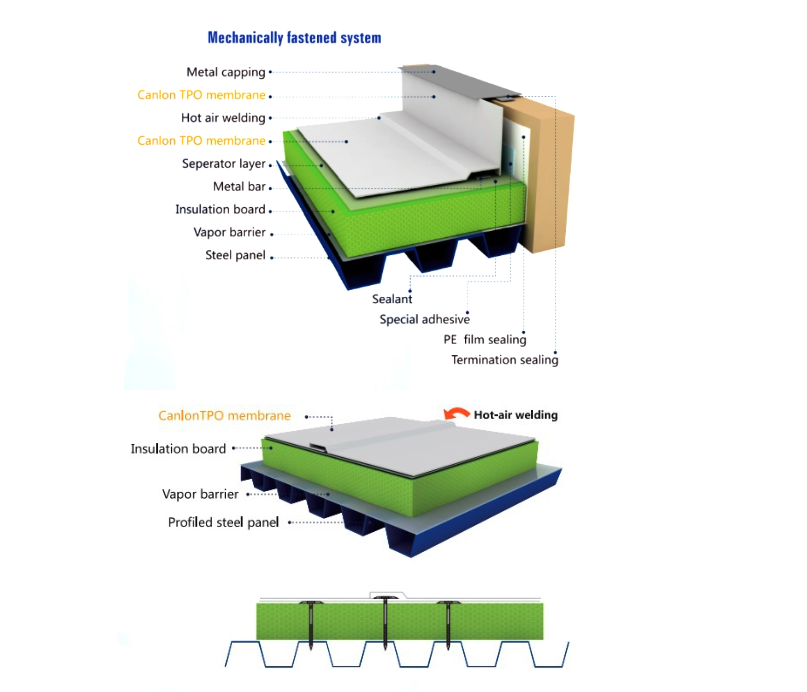
EN-certified TPO membranes are built to last. Compliance ensures they can endure heavy rain, wind, UV exposure, and temperature swings. Compared to non-certified membranes, they maintain strength, flexibility, and dimensional stability over time.
Key Advantages:
Greater resistance to tearing, punctures, and thermal stress
Predictable performance under long-term environmental loads
Reduced risk of premature replacement or roof failure
Buildings using certified membranes often see extended service life, lowering maintenance and replacement costs.
Safety is crucial in commercial roofing. EN-certified membranes meet strict fire performance standards such as EN 13501, protecting occupants and property.
Benefits Include:
Compliance with building codes and insurance requirements
Reduced risk of fire-related accidents and liabilities
Avoiding costly retrofits due to non-compliance
Using certified TPO reduces legal and financial exposure while enhancing peace of mind for property owners.
EN certification also addresses energy performance. Many certified TPO membranes offer high solar reflectance and thermal emissivity, helping control internal temperatures.
Why It Matters:
Supports green building certifications like LEED and BREEAM
Reduces energy consumption and cooling costs
Lowers carbon footprint through reflective, recyclable materials
Buildings benefit not only from operational savings but also from improved sustainability credentials.
EN-certified TPO membranes come in standardized dimensions and predictable properties. This consistency simplifies installation and ensures proper seam welding.
Installation & Maintenance Advantages:
Lower risk of seam failures or water leaks
Reduced labor errors during installation
Easier routine inspections and maintenance planning
For contractors, it streamlines workflow. For building owners, it guarantees a reliable, low-maintenance roofing system.
Before installation, always verify the membrane’s EN certification. This confirms it meets standards like EN 13956 for tensile strength, elongation, and dimensional stability.
Key Checks Include:
Certification Documents: Confirm batch numbers, testing reports, and CE marking
Membrane Thickness and Width: Ensure consistency with project specifications
Tensile Properties: Check manufacturer’s data to confirm compliance with EN mechanical criteria
These steps prevent installation errors and ensure long-term performance.
Installing EN-compliant TPO membranes correctly ensures maximum durability. Heat-welding seams is essential, creating a watertight barrier per EN standards.
Installation Guidelines:
Substrate Preparation: Clean, dry, and level the roof surface
Insulation Placement: Secure insulation boards to provide stability beneath the membrane
Membrane Alignment: Roll out sheets carefully, maintaining correct overlap for welding
Seam Heat Welding: Use certified hot-air equipment to fuse seams
Inspection: Check all seams, edges, and penetrations before, during, and after installation
Following these practices reduces risks of leaks, punctures, or seam failures.
Even with certified membranes, some challenges arise during installation. Understanding them helps prevent costly issues.
Typical Issues:
Seam Separation: Often caused by improper heat welding or substrate movement
Punctures: Accidental damage during installation or from rooftop traffic
UV Degradation: Exposure before permanent fixing can weaken the membrane
EN Standards Guidance:
Provide tolerances for seam strength, elongation, and puncture resistance
Recommend installation sequences and inspection methods
Offer solutions for correcting minor defects before membrane curing
By following EN recommendations, installers maintain both warranty compliance and roof longevity.
A: EN 13956 covers flexible sheets for waterproofing, including TPO membranes, defining material performance, durability, and testing requirements.
A: EN standards harmonize roofing regulations across Europe, focusing on durability, fire, and environmental criteria, while ASTM or ISO may use different methods or regional requirements.
A: Certified membranes typically carry full manufacturer warranties and meet insurer or regulatory fire and safety requirements, reducing liability risk.
A: Initial cost may be higher, but improved durability, fewer repairs, energy savings, and compliance make them cost-effective over the roof’s lifespan.
A: EN-tested reflectivity, thermal performance, and insulation properties support LEED, BREEAM, and other green building certifications, contributing to sustainability goals.
Choosing EN-certified TPO roofing membranes means your commercial building stays protected against weather, UV exposure, and fire hazards while saving on energy costs. With proper installation and routine maintenance, these membranes deliver long-lasting performance and peace of mind.
At Jiangsu Canlon Building Materials Co., Ltd., we provide high-quality, EN-compliant TPO membranes designed for durability, safety, and sustainability. Connect with us today to ensure your next roofing project meets the highest European standards and protects your investment for years to come.