
Views: 0 Author: Site Editor Publish Time: 2026-10-12 Origin: Site


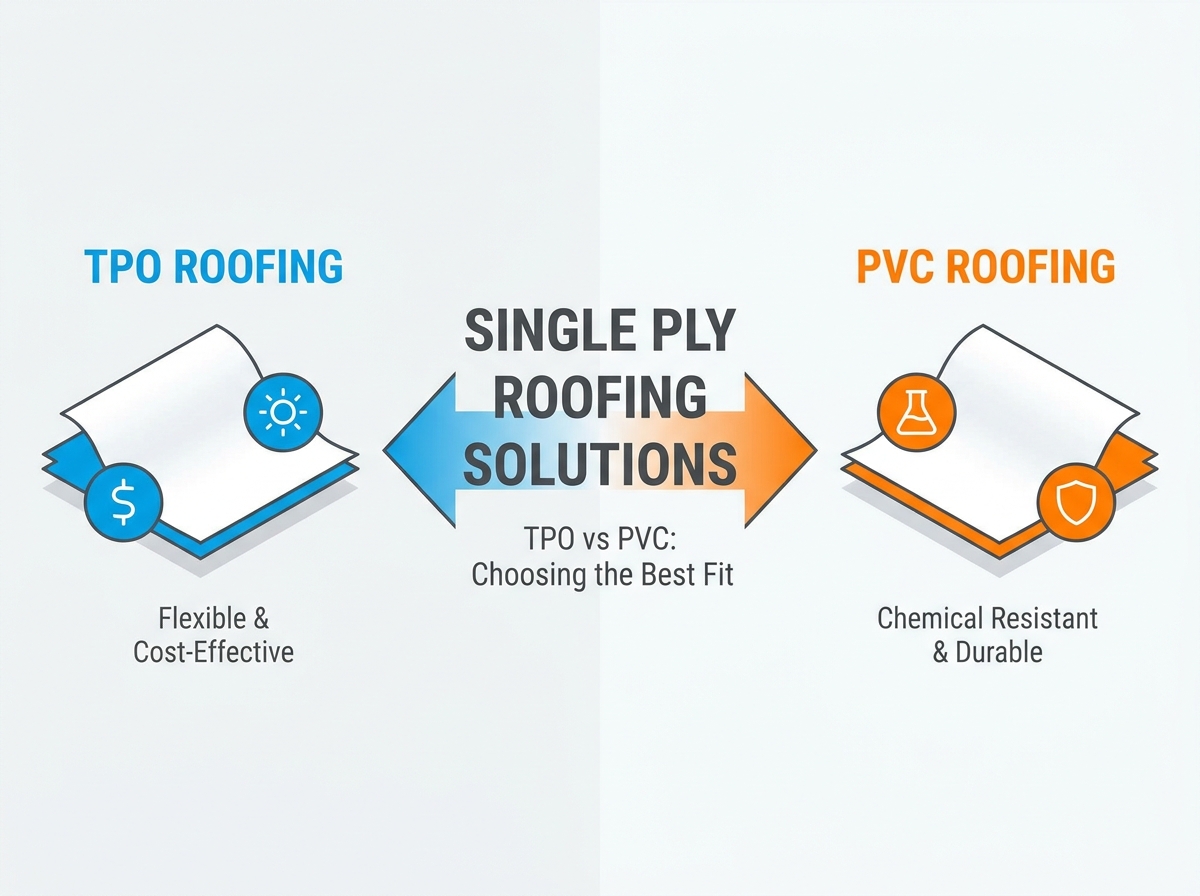
Choosing between TPO and PVC roofing systems is an important decision for commercial and industrial buildings. Both are thermoplastic single-ply membranes that can provide reliable waterproofing when the system is designed and installed correctly. However, their formulations, chemical resistance, product options, and project costs can differ.
The right choice depends on the building's use, rooftop exhaust, climate, roof structure, maintenance needs, and installation requirements. This guide compares TPO and PVC roofing membranes and explains how to evaluate the right solution for your project.
A single-ply roofing system uses a flexible membrane as its primary waterproofing layer. It is commonly used on flat and low-slope commercial roofs. The complete assembly may include a roof deck, vapor control layer, insulation, cover board, membrane, fasteners, and flashing details.
TPO and PVC are thermoplastic membranes. Their seams are commonly joined using hot-air welding. EPDM is a thermoset synthetic rubber membrane that generally uses compatible tapes, primers, or adhesives for seams.
The performance of a single-ply roof depends on more than the membrane itself. Roof design, drainage, substrate condition, attachment method, workmanship, and maintenance all affect long-term performance.
For an overview of available systems, visit Canlon's official Single Ply Roofing Solution page.
PVC, or polyvinyl chloride, roofing membrane is made from PVC resin and formulation additives, which may include plasticizers, stabilizers, and other processing agents. These ingredients help determine the membrane's flexibility, weathering performance, and chemical resistance.
PVC membranes can include a reinforcing layer to improve dimensional stability and mechanical performance. Product types may be designed for different substrates and installation methods.

PVC is often considered for roofs exposed to certain oils, grease, or industrial pollutants. However, chemical resistance depends on the specific formulation and the substance involved. Confirm compatibility with the manufacturer's technical documentation before specifying the membrane.
PVC seams are commonly hot-air welded. Correct surface preparation, welding settings, and seam inspection are important to achieve reliable joints.
Explore the product details on Canlon's official PVC Roofing Membrane page.
TPO, or thermoplastic polyolefin, is a roofing membrane made from a blend of polyolefin and rubber-related polymer components. Its formulation is different from flexible PVC and generally does not rely on the same type of liquid plasticizers.
TPO roofing membranes are available in different constructions. Depending on the product, options may include reinforced sheets, fleece-backed membranes, and non-reinforced membranes for specific detailing applications.

Many TPO products are designed for weather resistance and can offer high solar reflectance when supplied with a suitable light-colored surface. Actual performance depends on the membrane specification, surface condition, roof design, and climate.
TPO seams are commonly hot-air welded. Contractors must follow the manufacturer's welding procedures and inspect the seams during installation. Chemical exposure should also be reviewed before selecting TPO for a roof near exhaust outlets or industrial processes.
Review Canlon's official TPO Roofing Membrane page for available product types and specifications.
TPO and PVC share some installation characteristics, but they are not interchangeable in every project. Compare the specific product data and the demands of the building before making a decision.
| Comparison Factor | TPO Roofing | PVC Roofing |
|---|---|---|
| Material | Thermoplastic polyolefin | Polyvinyl chloride |
| Seam method | Commonly hot-air welded | Commonly hot-air welded |
| Chemical exposure | Compatibility should be checked for the specific product and exposure | Often considered for certain grease, oil, and industrial pollutant exposures; verify compatibility |
| Solar reflectance | Light-colored products may provide high reflectance | Light-colored products may provide high reflectance |
| Formulation considerations | Performance depends on polymer blend, stabilizers, reinforcement, and product design | Plasticizers and other additives affect flexibility, weathering, and chemical resistance |
| Installation factors | Welding settings, substrate, and workmanship are important | Welding settings, substrate, and workmanship are important |
| Cost | Compare local quotations and complete system costs | Compare local quotations and complete system costs |
| Service life | Depends on product, climate, installation, and maintenance | Depends on product, climate, installation, and maintenance |
Rooftop exhaust can expose a membrane to grease, oils, cleaning agents, fuel residues, or other chemicals. These substances may affect different membrane formulations in different ways.
PVC is often considered for some roofs with grease or industrial pollutant exposure. TPO may be suitable for many standard commercial applications where the expected exposure is compatible with the product. Neither choice should be made based on the material name alone.
Before selecting a membrane, identify the substances released near the roof, their concentration, temperature, and likely contact duration. Then check the manufacturer's chemical compatibility guidance and warranty requirements.
Both TPO and PVC products may be available in light colors that reflect solar radiation. Solar reflectance can help reduce heat absorption at the roof surface, but the result depends on the product and its condition over time.
Compare published weathering data, surface reflectance information, low-temperature flexibility, and the installation conditions for the specific products under consideration. Also assess insulation levels, drainage, and the building's energy requirements.
Canlon describes different TPO and PVC product constructions for different substrates and installation methods on its official roofing solution page.
Both TPO and PVC commonly use hot-air welding to join overlapping sheets. Reliable seams require suitable equipment, correct welding settings, proper surface preparation, and quality checks.
Do not assume that one membrane always has a wider welding window or that its seams are automatically stronger. Welding conditions vary by product, equipment, ambient temperature, and site conditions.
Contractors should follow the membrane manufacturer's installation instructions, complete test welds when required, and inspect seams using the approved quality-control procedure.
TPO and PVC use different polymer formulations. Their flexibility and weathering performance depend on the specific product design, additives, reinforcement, and exposure conditions.
PVC formulations may use plasticizers to achieve flexibility. Changes in formulation and long-term exposure can affect material properties. TPO does not use the same plasticizer system as flexible PVC, but it can still age under UV radiation, heat, and environmental stress.
Review product-specific test data rather than assuming that all TPO membranes or all PVC membranes will behave identically.
The initial membrane price is only one part of a roofing project's cost. Compare the full system, including insulation, cover board, fasteners or adhesives, flashing, labor, access equipment, inspections, maintenance, and warranty conditions.
TPO may be a cost-effective option for many standard commercial roofs. PVC may be worth evaluating where specific chemical exposure makes its documented resistance relevant. The best value depends on the building's needs and the complete installed system.
For roofs near kitchen exhausts or food-processing operations, identify the grease, oils, cleaning agents, and other substances that may reach the membrane. PVC may be a suitable candidate for some of these environments, but confirm compatibility with the specific product and exposure.
The design should also consider exhaust outlet locations, drainage, maintenance access, and the manufacturer's warranty requirements.
For standard commercial roofs without significant chemical exposure, compare TPO and PVC based on the complete system cost, reflectance, available product construction, installation method, and local climate.
TPO may offer an attractive balance of cost and performance for some projects. PVC may also be suitable, depending on the project specification and budget.
Industrial buildings require a site-specific assessment. Review exhaust outlets, chemical handling processes, rooftop equipment, maintenance traffic, and cleaning procedures.
If chemicals may contact the membrane, obtain product-specific compatibility information before choosing TPO or PVC. For more demanding exposures, consult the manufacturer or a qualified roofing consultant about suitable formulations and protective measures.
A suitable membrane can still fail if the roof assembly is designed or installed incorrectly. Select contractors with relevant experience in the proposed system and ask for references, installation procedures, and quality-control records.
The project specification should identify the approved membrane, substrate preparation, insulation, attachment method, flashing details, seam inspection, and maintenance requirements.
The membrane is only one component of the roof. Insulation, cover boards, drainage, perimeter details, and penetrations all affect system performance.
Consider suitable protection for areas with regular maintenance traffic. Ensure that walkway materials and attachment methods are compatible with the membrane manufacturer's instructions.
Read the warranty documents before selecting the final system. Confirm the covered components, workmanship provisions, inspection requirements, maintenance obligations, and exclusions.
Do not assume that a particular warranty covers every leak or repair cost. Coverage depends on the actual contract and the conditions stated by the manufacturer.
There is no single roofing membrane that is best for every commercial building. TPO and PVC both offer thermoplastic roofing options, but the right selection depends on the building environment, chemical exposure, roof design, budget, installation quality, and maintenance plan.
Before requesting bids:
Identify the building's rooftop exhaust, chemical exposure, and maintenance needs.
Compare product-specific weathering, flexibility, and chemical compatibility data.
Define the roof assembly, including insulation, cover board, attachment method, and flashing.
Request itemized bids based on the same technical specification.
Review installation procedures, warranty terms, and long-term maintenance requirements.
A project-specific evaluation helps building owners select a roofing system that meets their performance requirements without paying for features they do not need.
It depends on the building's use, chemical exposure, climate, roof design, and budget. Compare the technical data and total installed cost of the specific systems rather than choosing by material name alone.
PVC is often considered for roofs exposed to certain grease and oils. Confirm the exact substances and exposure conditions with the membrane manufacturer before selecting a product.
Both commonly use hot-air welding for seams. However, welding settings and installation procedures vary by product and must follow the manufacturer's instructions.
Service life depends on the product formulation, thickness, climate, installation quality, roof traffic, and maintenance. Use product-specific documentation and warranty conditions when estimating service life.
Compare chemical compatibility, weathering data, flexibility, membrane construction, installation requirements, complete system cost, maintenance needs, and warranty terms.