
Views: 0 Author: Site Editor Publish Time: 2026-10-09 Origin: Site


Commercial and industrial flat roof replacement requires careful material selection and installation planning. The wrong roofing membrane or attachment method can increase leakage risks, maintenance costs, and operational disruption.
Single-ply roofing systems use a flexible membrane as the primary waterproofing layer. TPO and PVC are common thermoplastic options for commercial and industrial roofs. EPDM is another option in markets where synthetic rubber membranes are widely used. Each material has different properties, installation requirements, and limitations.
This guide explains how to compare single-ply roofing membranes, evaluate installation methods, and reduce common replacement risks. It also covers the key questions building owners should address before requesting contractor bids.
A single-ply roofing system uses one flexible membrane as its primary waterproofing layer. The membrane works with other components, such as insulation, vapor control layers, cover boards, and fasteners, to form a complete roof assembly.
Compared with traditional built-up roofing, single-ply systems use a sheet membrane rather than multiple layers of asphalt and reinforcing felt as the main waterproofing component. The final performance depends on the membrane, roof deck, insulation, drainage, attachment method, and installation quality.
For commercial and industrial projects, review the complete Single Ply Roofing Solution rather than evaluating the membrane alone.
Single-ply membranes can be grouped by their material chemistry.
Thermoplastic membranes: TPO and PVC can generally be joined using hot-air welding. Correct welding conditions and workmanship are essential to seam quality.
Thermoset membranes: EPDM is a synthetic rubber membrane that is commonly joined using compatible primers, seam tapes, or adhesives. The specified system determines the appropriate seam procedure.
Neither category is automatically suitable for every roof. The correct choice depends on the building environment, roof design, product specifications, and installation requirements.
A commercial roof may include the following components, depending on the project design:
Roof deck: The structural base, which may be steel, concrete, or another approved substrate.
Vapor control layer: Helps control moisture movement through the roof assembly when required by the design.
Insulation: Provides thermal resistance and contributes to the roof's energy performance.
Tapered insulation: Helps establish drainage slopes where the roof design requires them.
Cover board: Provides a suitable surface for the membrane and can improve resistance to impact and foot traffic.
Waterproofing membrane: The exposed or protected layer that limits water penetration.
Attachment and flashing components: Secure the system and help maintain waterproofing around edges, penetrations, and transitions.
Start by identifying what happens on and around the roof. Restaurants, food-processing facilities, and some manufacturing plants may release grease, oils, or chemical exhaust near roof surfaces.
Chemical compatibility should be confirmed using the membrane manufacturer's technical documentation. Do not assume that every TPO, PVC, or EPDM formulation can tolerate every chemical. Check the chemical type, concentration, temperature, exposure duration, and cleaning method before making a selection.
For projects that require a thermoplastic membrane, compare the documented properties of the proposed TPO Roofing Membrane and PVC Roofing Membrane.
The roof membrane must suit local weather conditions. UV radiation, high surface temperatures, freezing conditions, wind, and repeated temperature changes can affect long-term performance.
Light-colored membranes may reflect more solar radiation than dark membranes, depending on the product surface and its condition. However, reflectivity alone does not determine the best roof system. Consider insulation, local energy requirements, roof exposure, and the manufacturer's documented weathering performance.
For cold climates, review the membrane's low-temperature flexibility and the system's ability to accommodate building movement. Confirm the relevant test data and installation limits rather than relying on a general material label.
Before selecting an attachment method, inspect the existing deck and assess its load-bearing capacity. Ballasted systems use added weight to hold the membrane in place, so the structure must be designed to support that load.
Mechanical fasteners also require a suitable substrate. Corrosion, deterioration, or weak pull-out resistance can affect attachment performance. Where necessary, qualified professionals should conduct pull-out tests and specify repairs or alternative attachment details.
Confirm applicable building codes, fire requirements, wind-uplift design criteria, and insurance requirements before finalizing the specification.
Approvals apply to defined roof assemblies and conditions. A membrane's product certification alone does not confirm that every combination of deck, insulation, fasteners, and attachment spacing is approved for a particular building.
Ask the manufacturer or qualified roof consultant to confirm that the proposed assembly meets the project's location, building height, edge-zone, and performance requirements.
TPO, PVC, and EPDM are common single-ply membrane categories, but their properties vary by formulation and product design.
| Factor | TPO | PVC | EPDM |
|---|---|---|---|
| Material category | Thermoplastic polyolefin | Polyvinyl chloride | Synthetic rubber |
| Typical seam method | Hot-air welding | Hot-air welding | Compatible seam tape or adhesive system |
| Key selection factors | Weathering performance, weldability, flexibility, and product-specific chemical compatibility | Weathering performance, weldability, and compatibility with expected exposure | Flexibility, seam-system requirements, and compatibility with roof conditions |
| Important checks | Product data, thickness, reinforcement, and installation requirements | Product data, plasticizer formulation, chemical exposure, and installation requirements | Reinforcement, seam details, adhesive compatibility, and maintenance requirements |
TPO is a thermoplastic membrane used in many commercial roofing applications. Product designs may include reinforcement or fleece backing, depending on the intended attachment method and roof assembly.
When evaluating TPO, review its thickness, reinforcement, weathering data, low-temperature flexibility, and welding requirements. Chemical resistance should be verified for the actual exposure conditions rather than assumed from the material name.
Explore the specifications and available types of Canlon TPO Roofing Membrane.
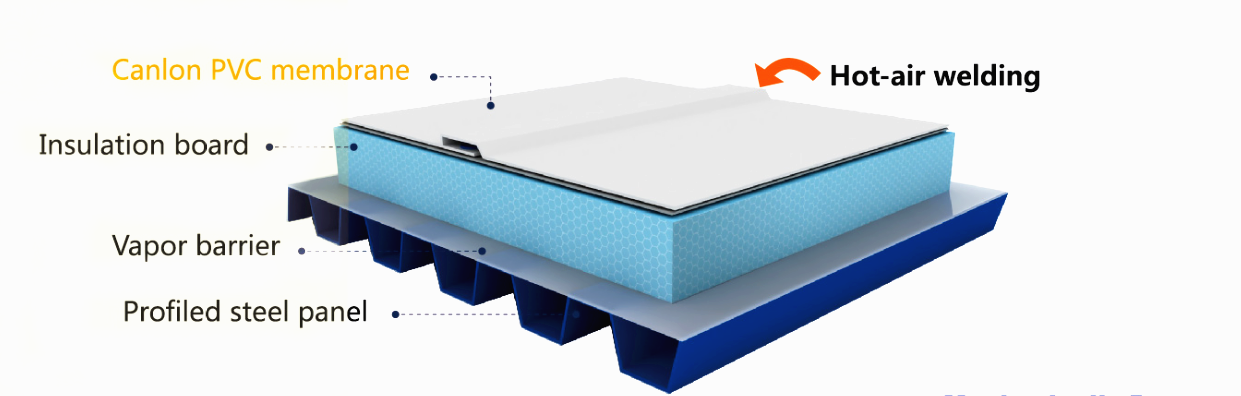
PVC roofing membranes are thermoplastic sheets that can generally be joined using hot-air welding. Their formulation may include plasticizers and other additives that affect flexibility, weathering, and chemical resistance.
PVC may be considered for projects where resistance to certain oils, grease, or industrial pollutants is important. Confirm compatibility with the specific substances present on the roof and review the product's technical documentation.
For available types and specifications, see Canlon PVC Roofing Membrane.
EPDM is a synthetic rubber membrane known for its flexibility. Depending on the system design, it may be fully adhered, mechanically attached, or ballasted. Seams generally rely on compatible tapes, primers, or adhesives rather than hot-air welding.
Before choosing EPDM, review the specified seam system, substrate compatibility, expected foot traffic, roof exposure, and maintenance requirements. Its performance depends on the complete assembly and workmanship, not just the membrane material.
The attachment method affects wind-uplift performance, installation requirements, repair access, and project cost. The final choice should follow the roof design and the tested or engineered system specification.
| Method | How It Works | Key Considerations |
|---|---|---|
| Mechanically attached | Fasteners and plates secure the membrane system to the deck, with seams treated according to the membrane type | Fastener layout, deck pull-out resistance, seam quality, and wind-uplift design |
| Induction welded | Compatible coated plates are secured below the membrane and bonded to it using an induction tool | System compatibility, plate placement, equipment, and quality control |
| Fully adhered | Compatible adhesive bonds the membrane to an approved substrate | Surface preparation, adhesive compatibility, weather conditions, and curing requirements |
| Ballasted | The membrane is held in place by specified ballast, such as pavers or aggregate | Structural load, wind design, drainage, membrane protection, and leak investigation access |
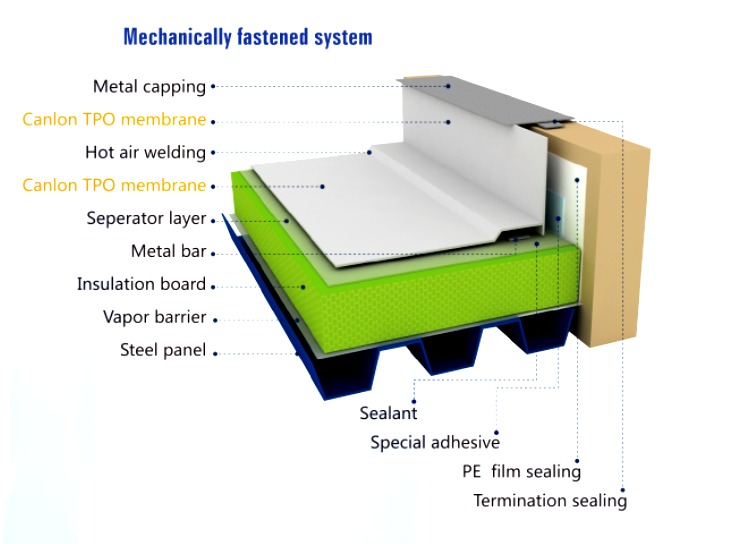
Mechanical attachment uses fasteners and plates to secure the roof assembly to a suitable deck. The membrane is installed according to the system design, and the seams are completed using the method specified for the membrane.
This method can be efficient on large roof areas. However, fastener spacing, deck condition, edge details, and wind-uplift requirements must be correctly designed and installed.
Induction welding uses compatible coated plates and specialized equipment to bond the membrane to the plates beneath it. The method can reduce direct membrane penetrations where the approved system is designed for this application.
The membrane, plates, insulation, and equipment must be compatible. Correct plate placement, temperature control, and inspection are essential to installation quality.
Fully adhered systems bond the membrane to an approved substrate using compatible adhesive. The substrate must be prepared according to the manufacturer's requirements.
Temperature, humidity, adhesive coverage, drying time, and application technique can affect the result. Contractors should follow the specified installation instructions and avoid applying products outside their permitted conditions.
Ballasted systems use specified aggregate or pavers to hold the membrane in place. Their feasibility depends on structural capacity, wind conditions, drainage design, and the protection requirements of the membrane.
The added load must be assessed by a qualified professional. Ballast can also make some leak locations more difficult to access, so inspection and repair planning should be considered during design.
A roof replacement may involve removing the existing assembly or installing a new system over an existing roof. The suitable option depends on local codes, the number and condition of existing layers, moisture levels, structural capacity, and the new system's requirements.
Moisture surveys can help identify suspect areas, but no single method detects every condition. Infrared scanning may be combined with core samples and visual inspection where appropriate. Wet or deteriorated materials should be addressed according to the project specification before the new system is installed.
For TPO and PVC, the quality of hot-air welded seams is critical. Incorrect temperature, travel speed, pressure, or surface preparation can result in weak or damaged seams.
Contractors should complete test welds and inspect seams in accordance with the membrane manufacturer's instructions and the project quality plan. Documented checks help identify problems before the installation progresses too far.
For EPDM, follow the specified surface preparation, primer, tape, and adhesive procedures. The correct seam process depends on the selected product system.
A new membrane cannot compensate for a wet or unstable roof assembly. Check the existing insulation, deck, drainage, and substrate before installation.
Where moisture is suspected, use suitable inspection methods and document the findings. Repair or replace damaged materials as required by the roof design and project specification.
Maintenance personnel and equipment can damage exposed membranes. Consider a suitable cover board and designated walkway pads in areas with regular access, subject to the roof-system manufacturer's requirements.
Protective walkways should lead to equipment that requires routine servicing. Ensure that walkway materials are compatible with the membrane and installed using the approved method.
Choose contractors with relevant experience in the proposed membrane and attachment system. Ask for references, training records where applicable, installation quality procedures, and a clear scope of work.
Review the warranty terms carefully. Confirm what is covered, which inspections are required, how repairs must be handled, and whether the proposed assembly meets the manufacturer's conditions.
Choosing a single-ply roofing membrane requires more than comparing material prices. Building use, chemical exposure, climate, deck condition, drainage, attachment method, and workmanship all affect the final result.
Before requesting bids:
Inspect the existing roof and investigate potential moisture or substrate problems.
Define the required insulation, cover board, membrane, attachment method, and drainage details.
Confirm that the proposed assembly meets applicable codes and project-specific wind, fire, and insurance requirements.
Compare itemized bids based on the same specifications.
Verify installation procedures, inspection requirements, maintenance responsibilities, and warranty conditions.
A well-designed and correctly installed roofing assembly can help reduce leakage risks and support long-term building performance.
Service life depends on the membrane formulation, thickness, installation quality, climate, roof traffic, maintenance, and warranty conditions. Review product-specific documentation and arrange regular inspections rather than relying on a single lifespan estimate.
The right thickness depends on the product system, exposure, expected traffic, local requirements, and project specification. Compare the manufacturer's available thicknesses and technical data. Do not assume that thickness alone determines service life or warranty eligibility.
TPO and PVC are thermoplastic membranes that are commonly joined by hot-air welding. EPDM is a synthetic rubber membrane that typically uses compatible tapes, primers, or adhesives for seams. The best choice depends on the roof environment and the selected product system.
Roof recovery may be possible if local codes, structural capacity, existing roof conditions, and the new system's requirements allow it. Moisture and damaged materials should be investigated before work begins. Some projects require complete tear-off.
Use a suitable roof design, prepare the substrate correctly, follow the membrane manufacturer's installation instructions, inspect seams and flashing details, protect high-traffic areas, and schedule routine roof maintenance. Documented quality checks can help identify installation problems early.