
Views: 0 Author: Site Editor Publish Time: 2026-07-29 Origin: Site


Urban densification and deep-basement designs have increasingly forced developers into zero-property-line construction, eliminating the spatial buffer required for traditional exterior excavation. When foundation walls are poured directly against soil retention systems, contractors lose access to the exterior face of the structural wall. Failing to adequately protect these inaccessible below-grade structures from hydrostatic pressure leads to catastrophic water ingress, structural degradation, and virtually impossible remediation scenarios.
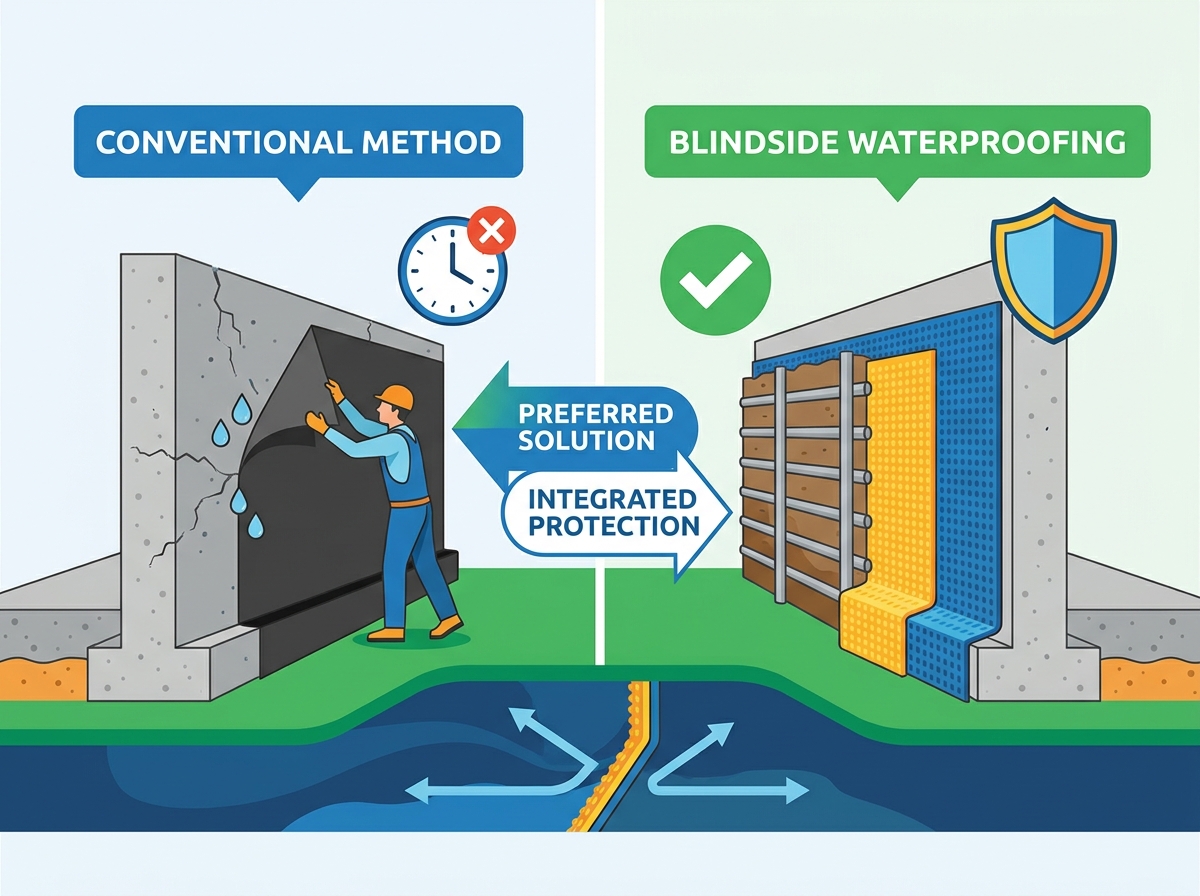
Blindside Waterproofing flips the traditional sequencing by installing the protective envelope before the structural concrete is placed. This guide evaluates the mechanics, membrane technologies, and implementation realities of blindside systems to help project teams specify the right solution for high-risk underground environments.
Site Constraints Dictate the Method: Blindside waterproofing is the mandatory approach for zero-lot-line sites, deep urban excavations, and tunnel construction where over-excavation is physically or legally impossible.
Adhesion is the Critical Metric: The success of a blindside system relies on its ability to form a continuous, mechanical, or chemical bond with the poured concrete to prevent lateral water migration if a puncture occurs.
Substrate Preparation is Non-Negotiable: The performance of the membrane is directly tied to the quality of the soil retention system (lagging, sheet piling, or shotcrete) it is installed against.
Risk Mitigation Outweighs Upfront Cost: While blindside materials and detailing require higher initial investment, they eliminate the exponentially higher costs of post-construction negative-side leak injection and structural repair.
Urban construction operates under severe physical limitations. Adjacent foundations, property lines, and utility corridors routinely prevent the standard two-to-three-foot over-excavation required for traditional positive-side waterproofing. Without this clearance, workers cannot access the exterior wall after the concrete cures to apply protective coatings, sheet membranes, or drainage boards. The structural wall must be cast directly against the temporary or permanent earth retention system. This spatial reality completely invalidates conventional waterproofing approaches, forcing a fundamental shift in how the building envelope is constructed and protected against groundwater intrusion.
Blindside waterproofing requires a complete reversal of the standard construction sequence. Understanding this shift is critical for project sequencing and risk management. The process generally follows these distinct phases:
Installation of the earth retention system, such as soldier piles and wood lagging, steel sheet piling, or secant walls.
Preparation of the substrate to ensure a relatively smooth, continuous surface free of large voids or sharp protrusions.
Application of the waterproofing membrane directly to the shoring system, with the active or adhesive face oriented toward the future concrete pour.
Installation of reinforcing steel (rebar) directly in front of the membrane, taking extreme care to avoid punctures.
Placement of the structural concrete or application of structural shotcrete against the membrane.
As the concrete cures, it forms a mechanical or chemical bond with the membrane, creating a permanent, integral seal that remains in place for the life of the structure.
The transition joint between the underslab horizontal waterproofing and the vertical wall membrane represents the most common point of failure in any below-grade envelope. This structural cold joint experiences significant stress during concrete placement, thermal cycling, and building settlement. Proper detailing requires reinforced gussets, continuous adhesive bonding, and often the integration of hydrophilic waterstops. If this intersection is compromised, groundwater under hydrostatic pressure will exploit the weakness, flooding the lowest levels of the structure. Field teams must execute this transition with absolute precision, as it bridges two distinct phases of construction that may be separated by weeks or months.
Once the concrete is poured, the membrane is permanently buried between the structural wall and the earth retention system. Remediation from the exterior is physically impossible. If a leak occurs, the only recourse is invasive interior negative-side injection using polyurethane or epoxy grouts. These repairs are highly disruptive, require the removal of interior finishes, and often provide only temporary relief as water simply migrates to the next path of least resistance. Choosing the correct system and executing flawless installation is critical because post-construction repairs fail to address the root cause of the breach.
Sodium bentonite is a naturally occurring clay that expands up to fifteen times its dry volume upon contact with water. When confined between the structural concrete and the soil retention system, this expansion forms a dense, low-permeability gel that blocks water ingress. These systems offer excellent self-healing capabilities for minor punctures and conform easily to irregular lagging surfaces. However, they carry significant risks. Bentonite is highly vulnerable to premature hydration from rain or standing water before the concrete is poured. If it expands before confinement, it loses its waterproofing capability. Furthermore, bentonite degrades rapidly in highly saline or contaminated groundwater, making thorough soil testing a prerequisite for specification.
These membranes combine a tough, puncture-resistant HDPE backing with an aggressive pressure-sensitive adhesive and a weather-resistant protective coating. The defining characteristic of these systems is their ability to form a permanent, integral bond with the concrete as it cures. This bond provides exceptional resistance to lateral water migration; if the membrane is punctured, water cannot travel between the plastic sheet and the concrete wall. HDPE systems also offer high chemical resistance. The primary challenge lies in installation. They require meticulous detailing at seams, often utilizing specialized tapes or heat welding, and are less forgiving on highly irregular substrates compared to bentonite or fluid-applied options.
Flexible thermoplastic (PVC) or elastomeric sheets provide excellent elongation and bridging capabilities, making them suitable for projects anticipating significant structural settlement or seismic activity. These systems are often compartmentalized using a grid of hydrophilic or PVC waterstops welded directly to the membrane. If a breach occurs, the waterstops confine the leak to a specific grid section, simplifying targeted injection repairs later. The major drawback is the heavy reliance on heat-welded seams. Achieving watertight integrity requires highly skilled labor, specialized equipment, and rigorous quality control testing of every seam before concrete placement.
Fluid-applied systems involve spray-applied or troweled membranes applied over a drainage board or carrier sheet, often paired with a polymer-modified asphalt layer. These solutions offer a monolithic, seamless installation that easily navigates complex penetrations like tie-backs, soil nails, and utility conduits. They eliminate the seam vulnerabilities inherent in sheet goods. However, achieving consistent mil thickness depends entirely on the applicator's skill. Furthermore, these materials require specific temperature and moisture conditions during application, making them highly susceptible to weather delays.
| System Type | Primary Mechanism | Key Advantage | Main Vulnerability |
|---|---|---|---|
| Bentonite Clay | Expansive gel formation under confinement | Self-healing, highly conformable to rough lagging | Premature hydration, sensitive to high salinity |
| HDPE / Fully Adhered | Integral adhesive bond with curing concrete | Prevents lateral water migration, high chemical resistance | Requires smooth substrate, strict seam detailing |
| PVC / Synthetic Rubber | Flexible sheet barrier with compartmentalization | High elongation, settlement bridging, targeted repair | Complex heat-welding, highly skilled labor required |
| Fluid-Applied / Hybrid | Monolithic coating over carrier sheet | Seamless, easily handles complex penetrations | Weather dependent, requires precise thickness control |
The membrane-to-concrete peel adhesion value, measured by ASTM D903, is the single most critical metric for evaluating blindside performance. In a deep foundation environment, punctures during rebar installation or concrete placement are a statistical probability. If a breach occurs, the system must localize the leak. Without strong adhesion, water entering through a pinhole will travel laterally between the membrane and the structural wall, eventually finding a crack or cold joint to enter the building. High peel adhesion ensures that any puncture remains isolated, preventing widespread water ingress and allowing for localized, manageable repairs.
Deep foundation scenarios subject membranes to continuous, high-head water pressure. A basement extending three levels below the water table can experience hydrostatic pressures exceeding 150 psi. Evaluating materials based on ASTM D5385 ensures the chosen system can withstand these extreme forces without rupturing, delaminating, or forcing water through microscopic imperfections in the seams. The membrane must maintain its structural integrity and adhesive bond under constant, relentless pressure for the entire design life of the structure.
Relying solely on a barrier membrane is a high-risk strategy. Incorporating a drainage board or dimple sheet between the earth retention system and the waterproofing membrane relieves hydrostatic head pressure. These geocomposites create a continuous void space that channels groundwater down to a weeping tile or base drainage system before it can test the membrane's limits. By removing the standing water pressure, the primary waterproofing layer acts as a secondary defense against dampness rather than a structural dam holding back a subterranean lake.
The membrane must survive the brutal realities of the construction phase. After installation, the membrane is subjected to the installation of heavy reinforcing steel, welding sparks, dropped tools, and the immense pressure of concrete placement. High puncture resistance, often achieved through thick HDPE backings or reinforced composite layers, ensures the membrane remains intact until the concrete cures. Field teams must balance the need for flexibility to navigate corners with the sheer toughness required to survive the rebar cage installation.
Matching the membrane material to the site's specific soil chemistry and groundwater contaminants is an absolute necessity. Urban environments often feature contaminated soils containing hydrocarbons, heavy metals, or industrial solvents. Coastal areas present high salinity challenges. Sulfates in the soil can degrade certain asphaltic or clay-based materials. A comprehensive geotechnical report must inform the specification process, ensuring the chosen membrane will not chemically degrade, swell improperly, or lose its adhesive properties when exposed to the specific groundwater profile of the site.
The performance of any blindside system is inextricably linked to the quality of the substrate it is installed against. Different shoring methods require specific preparation strategies to prevent membrane failure.
Soldier Pile and Wood Lagging: This common method often leaves significant gaps between lagging boards and irregular transitions at the steel piles. Preparation requires filling voids with grout or mastic, removing protruding nails, and often installing a continuous drainage board or plywood facing to create a suitable, uniform surface for membrane application.
Steel Sheet Piling: The deep corrugated profile and sharp edges of sheet piling present severe challenges. Applying sheet membranes directly to the corrugations often leads to bridging, where the membrane stretches across the void and tears under the weight of the concrete. Detailing requires filling the flutes with concrete or installing a heavy-duty plywood or foam profile to create a flat surface.
Secant Walls and Shotcrete: While generally more uniform than lagging, these surfaces can be highly abrasive. Surface profiling is required to remove sharp aggregate protrusions. A parge coat or heavy geotextile cushion layer is often necessary to prevent the membrane from tearing over rough contours during concrete placement.
The bulk field of the membrane rarely fails; leaks almost exclusively occur at penetrations, transitions, and terminations. Managing these details requires strict adherence to manufacturer protocols.
Penetrations involving plumbing, electrical conduits, and grounding rods demand strict sealing protocols using specialized boots, liquid-applied flashing, and stainless steel clamping rings.
Tie-backs and soil nails represent the most common leak points. They require specialized detailing boxes or mastic applications that can accommodate the irregular shape of the anchor head while maintaining a watertight seal.
Under-slab-to-wall transitions must bridge the structural cold joint seamlessly, often requiring a double layer of membrane and the integration of a hydrophilic waterstop.
Terminations at grade level require mechanical fastening with a termination bar and continuous counter-flashing to prevent surface water from migrating behind the membrane system.
The concrete pour itself presents significant hazards to the waterproofing envelope. During cast-in-place operations, improper vibration techniques can cause the vibrator head to strike and tear the membrane. Excessive drop heights can lead to aggregate segregation, causing heavy stones to impact and damage the waterproofing layer. Shotcrete applications introduce a different set of risks. The high impact velocity of the shotcrete can abrade or tear softer membranes. More critically, poor shotcrete application can lead to "shadowing"—the creation of voids or honeycombing behind the reinforcing steel. If the shotcrete does not fully encapsulate the rebar and make solid contact with the membrane, the required continuous adhesive bond is never formed, leaving a pathway for water migration.
Given the permanent inaccessibility of the system, rigorous quality assurance is the only defense against catastrophic failure. Relying solely on the installing contractor's visual check is insufficient.
Engage an independent third-party waterproofing inspector to review all details before concrete placement.
Conduct smoke testing on compartmentalized PVC systems to identify microscopic seam failures.
Perform holiday testing (spark testing) on fluid-applied systems to detect pinholes or areas of insufficient mil thickness.
Execute a final visual sign-off of all tie-back details, penetrations, and transition joints immediately prior to the concrete pour, ensuring no damage occurred during rebar installation.
The primary financial driver for adopting blindside techniques is the maximization of the buildable footprint. By eliminating the need for a two-to-three-foot over-excavation perimeter, developers can build the foundation walls directly against the property line. In dense urban environments where land acquisition costs are astronomical, capturing this additional subterranean square footage is highly lucrative. This expanded footprint allows for additional parking stalls, larger mechanical rooms, or expanded retail space, directly improving the project's overall return on investment and offsetting the specialized construction costs.
Blindside systems carry a distinct premium in both material costs and the specialized labor required for installation. The meticulous detailing, substrate preparation, and rigorous QA/QC processes demand a higher initial capital outlay compared to traditional positive-side damp-proofing. However, this upfront investment must be weighed against the lifecycle risks. A failed below-grade envelope results in catastrophic financial consequences, including structural water damage, extensive mold remediation, tenant disruption, and the need for continuous, expensive epoxy injections over the building's lifespan. Investing in a robust, fully adhered blindside system mitigates these long-term liabilities, ensuring the structural integrity and usability of the subterranean space.
Blindside waterproofing is one of the most reliable solutions for protecting below-grade structures where exterior access is unavailable after construction. By selecting the appropriate membrane system, ensuring proper detailing, and implementing rigorous quality control throughout installation, project teams can significantly reduce water ingress risks, improve structural durability, and minimize costly future remediation.
To maximize long-term waterproofing performance, consider the following recommendations:
Conduct comprehensive geotechnical investigations and groundwater assessments before selecting a blindside waterproofing system.
Choose membrane technologies based on substrate conditions, hydrostatic pressure, and project-specific environmental requirements.
Pay close attention to critical details such as penetrations, transitions, and horizontal-to-vertical connections during installation.
Implement independent inspection and quality assurance procedures before concrete placement to ensure long-term waterproofing reliability.
With decades of expertise in waterproofing technology and building envelope innovation, CANLON has established itself as a globally recognized manufacturer of advanced waterproofing systems for commercial, industrial, infrastructure, and residential construction. Through continuous research and development, intelligent manufacturing, and strict international quality standards, the company delivers high-performance waterproofing solutions that meet the demanding requirements of modern underground and structural construction projects.
From blindside waterproofing membranes and below-grade waterproofing systems to roofing waterproofing and integrated building envelope solutions, CANLON offers comprehensive products, professional engineering consultation, customized project support, and long-term technical services. By combining innovative technology with sustainable product development, CANLON helps architects, engineers, contractors, and developers improve construction quality, extend building lifespan, and create safer, more durable, and resilient structures.
A: Positive side waterproofing is applied to the exterior of a cured concrete wall, requiring excavation space for worker access. Blindside waterproofing is applied to the soil retention system before the structural wall is poured against it, utilized when exterior access is physically impossible due to zero-lot-line constraints.
A: Exterior repairs are impossible once the concrete cures because the membrane is permanently buried. Remediation requires invasive interior negative-side injections using polyurethane or epoxy grouts, which are highly disruptive and often only provide temporary solutions.
A: A smooth, continuous substrate is ideal. Plywood facing over rough wood lagging, concrete-filled flutes on sheet piling, or a parge coat over rough shotcrete provides the necessary uniform surface for proper membrane adhesion and prevents bridging or tearing.
A: If a membrane is punctured, water can travel laterally between the membrane and the concrete wall until it finds a crack to enter the building. Systems with high peel adhesion bond directly to the concrete, localizing the leak and preventing this widespread migration.
A: Yes, but it requires specific membranes designed to withstand the high impact velocity of the application. Careful nozzle technique is required to prevent "shadowing" or voids behind the rebar, which would compromise the critical adhesive bond between the concrete and the membrane.
A: Penetrations require meticulous detailing using specialized pre-formed boots, mastic, or fluid-applied liquid flashing to create a watertight seal around the protrusion before the main field membrane is installed and integrated.
A: This horizontal-to-vertical transition is a critical structural cold joint. It requires reinforced detailing, overlapping membranes, continuous adhesive bonding, and often the integration of hydrophilic waterstops to maintain a monolithic seal against hydrostatic pressure.