
Views: 0 Author: Site Editor Publish Time: 2026-07-29 Origin: Site


Deep excavations and zero-lot-line urban construction projects face catastrophic financial, operational, and structural risks from below-grade water ingress. Traditional positive-side waterproofing requires exterior access to the foundation wall after the concrete is poured. In dense urban environments, deep basements, or tight property lines, this exterior access is physically impossible. Blindside Waterproofing, also known as pre-applied waterproofing, serves as the necessary engineering solution. This guide provides an authoritative technical evaluation for architects, structural engineers, and developers to select, specify, and successfully implement the right pre-applied system. We will cover the exact mechanics of adhesion, material selection criteria based on soil chemistry, and the rigorous quality control protocols required before the concrete trucks arrive on site.
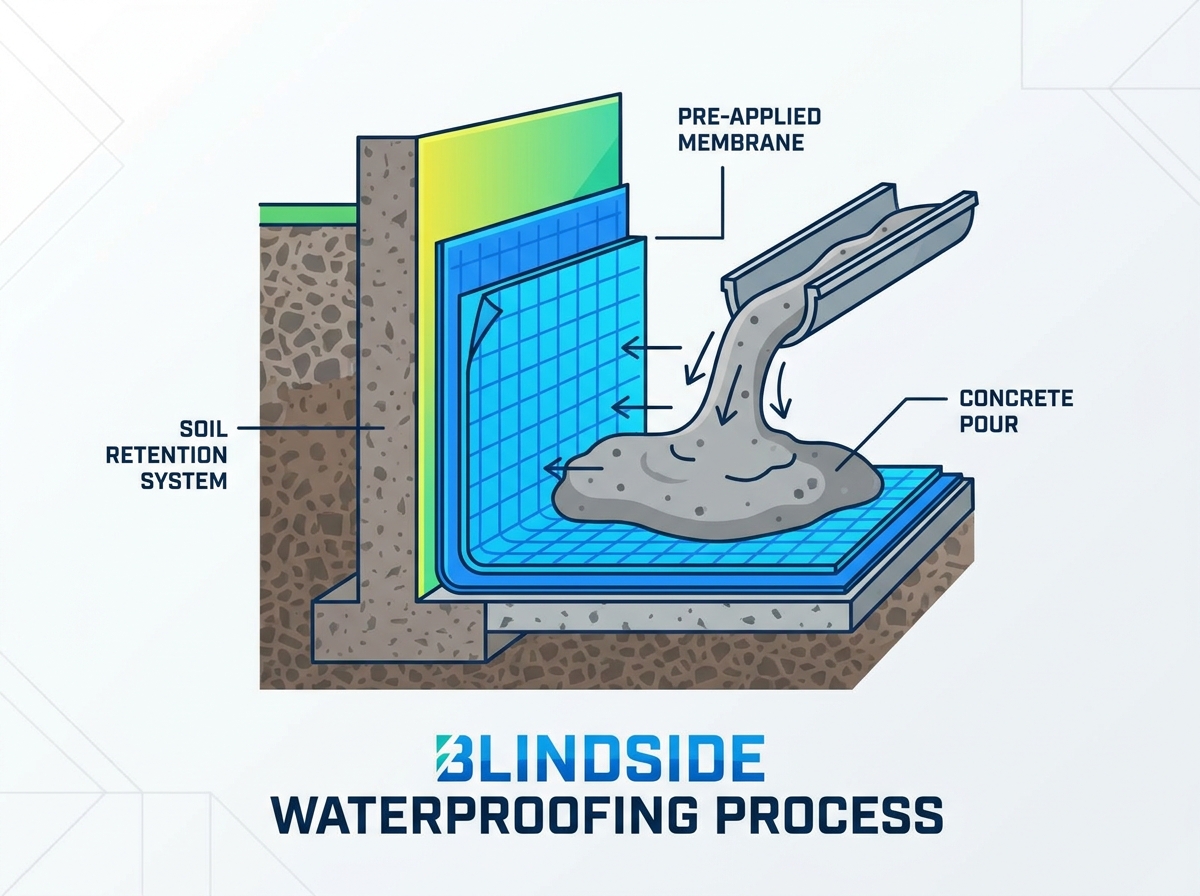
Definition & Application: Blindside waterproofing is installed *before* the structural concrete is placed, bonding mechanically or chemically to the wet concrete as it cures.
Site-Driven Selection: Material selection (HDPE, Bentonite, PVC, Hybrid) must be dictated by site-specific geotechnical reports, hydrostatic pressure, and soil chemistry, not just upfront material costs.
Zero Margin for Error: Because the membrane is buried behind the structural wall and the earth retention system, post-construction repairs are highly invasive, complex, and expensive.
QA/QC is Critical: The highest risk of failure occurs during the installation of structural reinforcement (rebar) and concrete placement; rigorous inspection protocols and specialized detailing are mandatory.

Pre-applied systems reverse the traditional waterproofing sequence. Crews install the membrane directly against the soil retention system or shoring wall. Structural concrete is then poured directly against the membrane. This reversed sequence demands specialized adhesion mechanics to ensure the membrane integrates completely with the foundation. You cannot rely on gravity or backfill pressure to hold the membrane in place; the bond must be integral to the concrete itself.
Adhesion occurs through two primary mechanisms. Mechanical adhesion relies on fiber mesh, geotextile backing, or specialized textures that become permanently embedded in the wet concrete paste as it cures. Chemical adhesion utilizes pressure-sensitive adhesives (PSA) that react with the hydrating concrete to form a continuous, monolithic bond. This continuous bond creates a lateral water migration barrier. If a localized puncture occurs during construction, the tight bond prevents water from tracking laterally between the membrane and the concrete structure, isolating the leak and protecting the interior.
Evaluating waterproofing approaches requires comparing accessibility, installation sequence, risk profiles, and ease of localized repair. Positive-side systems are applied to the exterior of a completed foundation wall, allowing inspectors to verify the membrane before backfilling. Repairs are straightforward before the soil is replaced.
| Feature | Positive-Side Waterproofing | Blindside Waterproofing |
|---|---|---|
| Installation Timing | After structural concrete is poured and cured. | Before structural concrete is poured. |
| Substrate | Finished concrete foundation wall. | Earth retention system (shoring, lagging, shotcrete). |
| Accessibility | High. Exterior trench remains open until backfill. | Zero. Membrane is trapped between earth and concrete. |
| Repairability | Simple exterior patching prior to backfill. | Requires invasive interior chemical grout injection. |
Pre-applied systems carry an inherently higher risk profile. The membrane remains exposed to construction foot traffic, falling rebar, welding sparks, and adverse weather conditions for weeks prior to the concrete pour. Once the concrete cures, the membrane is permanently trapped between the earth retention system and the structural wall. This makes localized post-construction repairs highly invasive and complex, demanding flawless initial execution.
Certain site conditions make pre-applied systems the only viable engineering choice. Zero-lot-line or property-line construction, where the building footprint extends to the physical limits of the property, prevents any exterior access. Deep excavations utilizing earth retention systems like secant piles, sheet piling, soldier pile and lagging, or diaphragm walls require membranes to be applied directly to the shoring.
Under-slab applications also mandate this approach. Foundation rafts, mats, or slabs-on-grade subject to high water tables require a continuous barrier laid over the mud slab before structural steel placement. Additionally, civil infrastructure projects such as tunneling, subways, elevator pits, and deep utility vaults rely heavily on pre-applied technologies to manage extreme hydrostatic pressures.
Active clay systems utilize sodium bentonite needle-punched between geotextiles or integrated into polymer sheets. Upon contact with water, the bentonite swells up to 15 times its dry volume. Confined between the soil and the concrete, this swelling forms a dense, self-sealing, low-permeability gel. Field crews often favor bentonite for its forgiving nature on rough substrates.
The primary advantage is its self-healing property. The expanding gel can seal minor concrete cracks and small punctures automatically. It is highly flexible and conforms easily to irregular substrates like rough shotcrete. However, bentonite is vulnerable to premature hydration if exposed to rain or groundwater prior to concrete placement. Furthermore, its performance degrades significantly in soils with high groundwater salinity or heavy chemical contaminants.
HDPE systems consist of non-reactive, heavy-duty thermoplastic physical barriers. They are coated with a pressure-sensitive adhesive and a protective release or reflective coating. This design forms a continuous mechanical and chemical bond with the poured concrete. When specifying Blindside Waterproofing for deep urban basements, HDPE is frequently the default choice due to its robust physical properties.
These membranes offer exceptional resistance to high hydrostatic pressure, often tested up to 70 meters of head pressure under ASTM D5385. They are highly resistant to aggressive soil chemicals and ground gases, including radon, methane, and volatile organic compounds (VOCs). The drawback is that HDPE requires a relatively smooth substrate to prevent punctures. Detailing around complex, multi-angled penetrations is labor-intensive and relies heavily on specialized accessory tapes.
PVC and TPO systems feature flexible, thick thermoplastic sheets engineered specifically for pre-applied applications. They often utilize compartmentalization grids and integrated waterstops to isolate potential leaks into manageable zones. This compartmentalization is a massive advantage for long-term facility maintenance.
These materials provide superior tear and puncture resistance. Heat-welded seams offer verifiable, monolithic water tightness that adhesive tapes cannot match. They remain highly flexible even in low temperatures. However, they require higher material investments and specialized installation labor. Precise welding equipment and rigorous testing protocols are mandatory to ensure seam integrity.
Hybrid systems combine active and passive technologies. A common configuration is an HDPE barrier laminated with an active polymer-modified bentonite or a swellable hydrophilic core. This approach provides redundancy in protection, giving engineers peace of mind on high-risk sites.
Hybrid membranes mitigate the weaknesses of single-material systems by offering physical barrier resistance paired with self-healing capabilities. Installers must strictly adhere to proprietary manufacturer-specific accessories and installation guidelines to maintain warranty coverage. Mixing and matching tapes or mastics from different manufacturers will void the system warranty immediately.
Engineers must clearly define when a site requires a continuous hydrostatic barrier versus gravity-drained damp-proofing. Sites with temporary perched water or high historical water tables demand robust waterproofing. Damp-proofing only manages moisture vapor and unpressurized water. You cannot substitute a drainage board for a true hydrostatic barrier when the water table sits above the lowest slab elevation.
Hydrostatic head resistance ratings must match the site's maximum anticipated historical and seasonal high-water table levels. Engineers verify these capacities using ASTM D5385 or equivalent international standards. An engineering safety factor is always applied to account for future water table fluctuations or adjacent site developments altering groundwater flow.
The interface between the shoring and the membrane dictates the preparation requirements. Wood lagging often presents uneven boards, knots, and gaps. This requires a drainage composite or plywood facing to create a suitable substrate. Sheet piling and secant piles feature irregular profiles and deep recesses. These conditions necessitate profiling, sand-cement infills, or heavy-duty protection geofabrics to prevent the membrane from tearing under the weight of the concrete.
Inspect the shoring wall for sharp protrusions, exposed tie-back cables, or excessive gaps between lagging boards.
Apply a parge coat or install a heavy-duty drainage composite to bridge gaps and create a uniform surface.
Install the membrane strictly according to the manufacturer's fastening pattern to prevent sagging under the weight of the concrete.
Detail all penetrations and tie-back heads before installing the main field membrane.
Shotcrete shoring presents high surface roughness. Engineers must specify smoothing layers or parge coats to prevent localized punctures during the concrete pour. The substrate must be stable, sound, and free of sharp protrusions before any membrane deployment begins.
Geotechnical reports drive membrane chemistry selection. Sulfates, chlorides, organic hydrocarbons, and extreme pH levels can rapidly degrade specific membrane materials. Standard sodium bentonite fails to hydrate properly in highly saline environments. In such cases, specialized polymer-modified bentonite or synthetic HDPE/PVC systems are required.
Brownfield sites often require gas and vapor mitigation. Engineers must integrate gas-barrier properties for radon, methane, and VOCs with the waterproofing performance. The selected system must pass stringent ASTM and EPA standards for both water and gas exclusion. Always request site-specific chemical compatibility testing from the membrane manufacturer if the geotechnical report flags unusual soil contaminants.
Climatic vulnerabilities heavily impact installation success. Heavy rain can prematurely swell bentonite systems, rendering them useless before the concrete is poured. Freezing temperatures can make PVC membranes brittle and hinder the curing of liquid adhesives. Extreme heat can soften pressure-sensitive adhesives, causing vertical membrane sheets to sag or detach from the shoring wall. Project schedules must align with the climatic limitations of the chosen membrane technology.
Almost all pre-applied waterproofing failures occur at penetrations and structural transitions rather than the field membrane. This reality makes detail engineering the most critical phase of the design. Standardizing detailing protocols is essential. A single unsealed pipe penetration will compromise the entire foundation.
Engineers must specify swellable hydrophilic waterstops, liquid-applied polyurethane or epoxy mastics, compression flanges, and target patches for every pipe or conduit breaching the foundation. Tie-back cover assemblies require special attention. Temporary structural bracing, soil nails, and active tie-back heads must be encapsulated using specialized prefabricated plastic or steel cover boxes filled with detailing mastic.
Pile cap interfaces represent structural load-bearing zones where membranes cannot easily pass through. Membranes must terminate or transition to specialized cementitious or epoxy grout barriers that can withstand the compressive loads while maintaining a watertight seal. You cannot run a compressible membrane under a heavily loaded pile cap without risking structural settlement.
The slab-to-wall transition, often called the kick-out detail, is another vulnerable junction. Engineering this critical transition corner from the horizontal under-slab waterproofing to the vertical shoring walls requires precise overlapping, reinforced corner detailing, and often a secondary liquid membrane application to handle differential settlement.
Concrete shrinks and moves, making joints highly susceptible to water ingress. Active and static joints must be protected. Heavy-duty PVC waterstops and waterstop profiles with central bulbs accommodate movement while blocking water. These waterstops must be securely tied to the rebar cage to prevent displacement during the concrete pour.
For high-risk deep excavations, engineers incorporate emergency re-injectable grouting hoses into construction cold joints. If a leak occurs years after construction, maintenance teams can pump hydrophilic grout through these hoses to seal the joint without excavating the exterior. This provides a permanent, built-in repair mechanism for the most vulnerable parts of the foundation.
Rigorous inspection protocols are mandatory before authorizing the concrete pour. Seam integrity auditing is the first step. Inspectors verify adhesive overlaps and conduct peel testing or air-channel testing on heat-welded seams. Mechanical fastening patterns must match the manufacturer's specifications to prevent sagging.
Damage assessment protocols focus on locating and patching punctures, tears, or localized wrinkling. The installation of steel reinforcing bars (rebar) often damages the membrane. Inspectors must walk the site with the waterproofing contractor to apply target patches over any breaches caused by rebar tying, welding sparks, or dropped tools. Do not allow the concrete contractor to begin pouring until the waterproofing inspector signs off on the final patch.
The concrete pour itself presents massive risks to the membrane. High-velocity concrete dropping from pump hoses can scour the adhesive coating or tear the membrane off the shoring wall. Pouring protocols must limit the drop height and control the flow rate. Use tremie pipes or elephant trunks to guide the concrete safely to the bottom of the formwork.
Internal vibrators used to consolidate the concrete must be handled carefully. If a vibrator head contacts the membrane, it will instantly destroy the material. Contractors must use rubber-tipped vibrators and maintain a safe distance from the waterproofing layer. Continuous monitoring during the pour ensures the membrane remains intact and fully bonded to the curing structure.
Blindside waterproofing has become an essential solution for modern below-grade construction, especially in zero-lot-line developments, deep excavations, and complex underground infrastructure projects where traditional exterior waterproofing is not feasible. By selecting the appropriate membrane technology, implementing rigorous quality control, and paying close attention to critical detailing, project teams can significantly reduce water ingress risks, extend structural service life, and minimize long-term maintenance costs.
To maximize waterproofing performance, consider the following recommendations:
Base membrane selection on detailed geotechnical investigations, hydrostatic pressure analysis, and site-specific environmental conditions.
Choose waterproofing systems that match the project's structural movement, soil chemistry, and long-term durability requirements.
Pay special attention to penetrations, construction joints, tie-backs, and transition details during installation.
Implement comprehensive third-party inspections and quality assurance procedures before and during concrete placement.
With decades of experience in waterproofing technology and building envelope innovation, CANLON has established itself as a trusted global manufacturer of advanced waterproofing systems for commercial buildings, infrastructure, transportation projects, industrial facilities, and residential developments. Through continuous investment in research and development, intelligent manufacturing, and internationally recognized quality standards, the company delivers high-performance waterproofing solutions that meet the evolving demands of modern underground construction.
From blindside waterproofing systems and pre-applied waterproofing membranes to roofing waterproofing and integrated building envelope solutions, CANLON provides comprehensive product portfolios, engineering expertise, customized project support, and long-term technical services. By combining innovative materials with sustainable construction technologies, CANLON helps architects, engineers, contractors, and developers create safer, more durable, and longer-lasting structures across projects worldwide.
A: Positive-side waterproofing is applied to the exterior of a completed foundation wall, requiring excavation space. Blindside systems are installed before the concrete is poured, attached directly to the earth retention system, making them essential for zero-lot-line projects where exterior access is impossible.
A: Post-construction repairs are extremely difficult and invasive because the membrane is trapped between the soil and the concrete wall. Repairs typically require interior negative-side chemical grout injection to stop leaks, highlighting the need for flawless initial installation.
A: Pre-applied membranes bond either mechanically or chemically. Mechanical bonds use fibers or textures that embed into the wet concrete. Chemical bonds use pressure-sensitive adhesives that react with the hydrating concrete to form a continuous, monolithic seal.
A: Sodium bentonite relies on absorbing water to swell and create a seal. High salinity in groundwater or heavy chemical contaminants can inhibit this swelling process, rendering the clay ineffective. Specialized polymer-modified bentonite or synthetic membranes are required in these conditions.
A: The highest risk occurs during the placement of structural rebar and the concrete pour. Dropped tools, welding sparks, and concrete vibrators can easily puncture or tear the exposed membrane, requiring rigorous inspection and patching before the concrete cures.
A: It depends on the shoring type and water table. Wood lagging often requires a drainage composite to provide a smooth substrate and manage perched water. However, below the permanent water table, the system relies entirely on hydrostatic resistance, not drainage.