
Views: 0 Author: Site Editor Publish Time: 2026-08-13 Origin: Site


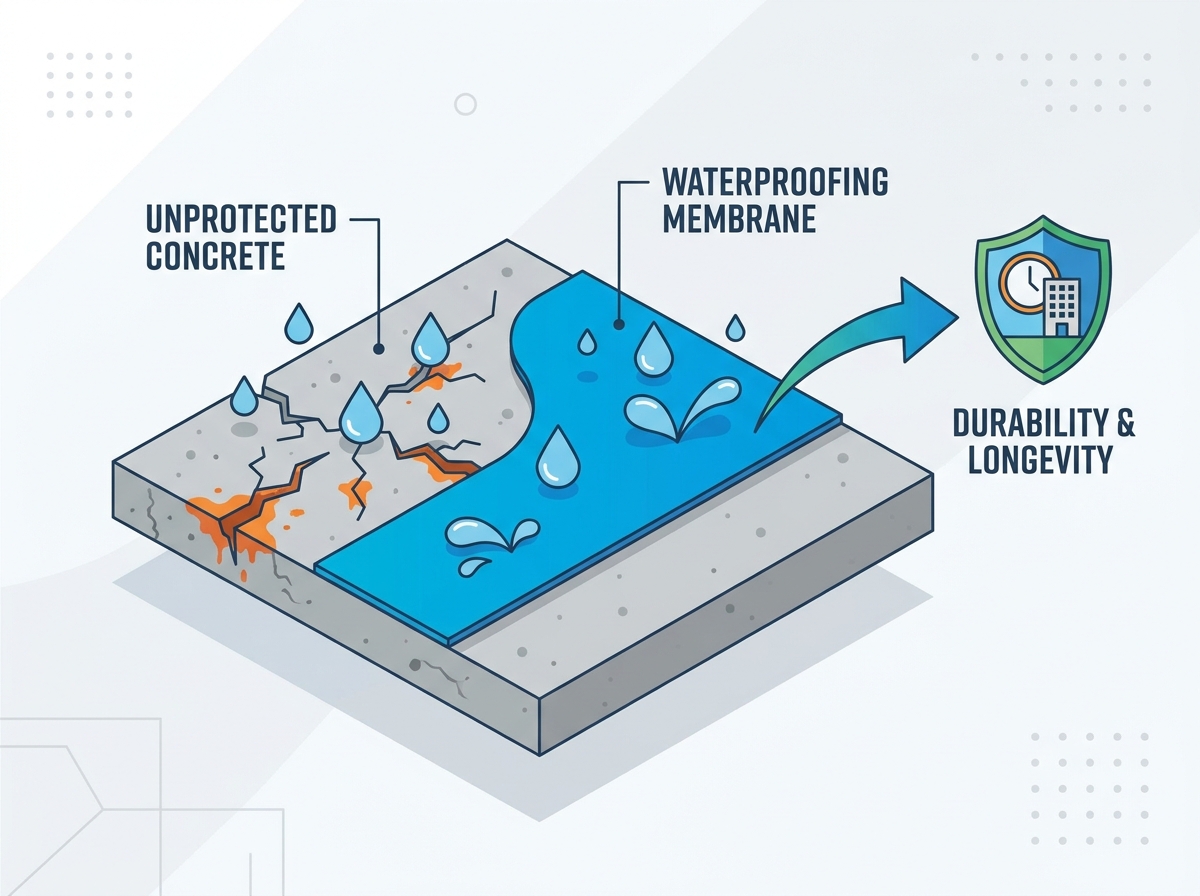
Bare concrete looks solid, but it acts much like a rigid sponge. Despite massive compressive strength, a bare slab remains highly porous. Environmental stress, structural settling, and temperature swings inevitably cause micro-cracking across the surface. When you leave a deck unprotected, these microscopic fissures become direct highways for moisture. Unprotected slabs allow water intrusion that initiates a destructive chain reaction. Water reaches the reinforcing steel, causing rust and expansion. Internal thermal insulation becomes saturated, losing its R-value entirely. Interior water damage disrupts daily operations and damages assets below. Relying on reactive patching to fix leaks as they appear is a losing battle against physics. Transitioning from reactive patching to proactive asset protection requires a fundamental shift in building envelope management. Securing the structure demands the specification of high-performance Roof Waterproofing Membranes. These systems completely seal the building envelope. They stop water ingress at the surface level, prevent structural degradation, and extend the facility's lifecycle.
Structural Shielding: Waterproof membranes act as the primary defense against water ingress, preventing the oxidation of reinforcing steel and subsequent concrete spalling.
Thermal and Movement Accommodation: High-quality membranes offer crack-bridging capabilities that flex with the concrete's natural thermal expansion and contraction.
Material-to-Application Match: The choice between liquid-applied, bituminous, and single-ply synthetic membranes must be dictated by roof complexity, climate, application method, and expected foot traffic.
Lifecycle Reality vs. "Permanent" Myths: While no solution is infinitely permanent, proper membrane selection, rigorous surface preparation, and scheduled maintenance drastically maximize longevity and ROI.
Concrete contains a vast, microscopic network of capillary pores formed during the hydration and curing process. When water pools on a flat or low-slope deck, capillary action draws this moisture deep into the concrete matrix. This water carries dissolved oxygen and environmental chlorides directly toward the embedded reinforcing steel. Initially, the highly alkaline environment of new concrete protects the rebar with a passive oxide film. Continuous water ingress, however, lowers this pH level through carbonation and destroys the protective layer.
Once the passive layer fails, the chemical process of oxidation begins. Trapped moisture and oxygen react with the steel, causing it to rust. Rust is not merely a surface stain; it is a chemical transformation that causes the steel to expand up to seven times its original volume. This massive volumetric expansion exerts immense internal tensile stress on the surrounding concrete. Because concrete possesses low tensile strength, this internal pressure causes the concrete to crack, delaminate, and eventually spall off in large chunks. This phenomenon, known in the field as rust jacking, compromises the structural load-bearing capacity of the deck. Protecting the Concrete Roof with a continuous barrier is the only way to arrest this chemical degradation before it requires deep structural patching.
Rooftops endure the most severe environmental conditions of any building component. Daily and seasonal temperature fluctuations subject the slab to relentless thermal stress. During peak daylight hours, the deck absorbs massive amounts of solar radiation, causing the material to expand. As the sun sets and temperatures drop, the slab rapidly cools and contracts. This continuous cycle of expansion and contraction induces severe thermal fatigue over the years.
In colder climates, this process is exacerbated by freeze-thaw cycles. Water that has penetrated the surface pores freezes overnight, expanding by approximately nine percent. This expansion acts like microscopic wedges inside the concrete. Over multiple seasons, these forces inevitably form micro-cracks across the surface. While initially invisible to the naked eye, these micro-cracks serve as direct, low-resistance pathways for bulk water intrusion during the next rainstorm. Without a flexible barrier to bridge these dynamic cracks, the structural integrity of the deck degrades exponentially, leading to active leaks inside the building.
Moisture penetration extends its damage far beyond the slab itself. Modern roof assemblies typically include layers of thermal insulation, such as polyisocyanurate (polyiso) or expanded polystyrene (EPS), designed to regulate building temperatures and reduce energy consumption. When water bypasses the surface, it often saturates the underlying or adjacent insulation layers. Wet insulation completely loses its thermal resistance. The trapped water conducts heat away from the building in winter and allows solar heat to penetrate during summer, causing HVAC systems to overwork and energy bills to spike.
Furthermore, damp environments create the perfect breeding ground for biological growth. Mold, mildew, and fungus thrive in dark, moist spaces within the assembly. This biological growth degrades organic building materials and poses severe health risks to building occupants. Spores can infiltrate the building's HVAC intake systems, leading to poor indoor air quality and potential respiratory issues. Maintaining a dry substrate is a non-negotiable requirement for both structural health and occupant safety.
The primary function of a modern waterproofing system is to accommodate the inevitable movement of the substrate. High-performance membranes possess elastomeric properties, meaning they can stretch and recover their original shape without sustaining damage. This elongation capability is required for crack-bridging. When thermal stress causes a micro-crack in the deck to open and close, the elastomeric membrane stretches over the gap rather than snapping.
This dynamic flexibility ensures that the waterproof barrier remains completely intact, even as the building shifts and settles over time. Rigid coatings or bare concrete simply fracture under these same stresses. By maintaining a continuous, unbroken seal over moving cracks, elastomeric membranes drastically improve the overall Durability of the assembly, preventing water from exploiting structural movement. We regularly see high-grade polyurethane systems stretch over 400% to accommodate shifting expansion joints without tearing.
Continuous exposure to ultraviolet radiation breaks down the molecular bonds in many building materials, causing them to become brittle, chalky, and prone to failure. Premium membranes are engineered to withstand decades of direct sunlight. Many liquid-applied systems utilize aliphatic polyurethane topcoats, which are chemically resistant to UV degradation and will not yellow or chalk over time, unlike their aromatic counterparts.
Additionally, many membranes feature highly reflective white or light-colored surfaces. These reflective finishes bounce a significant portion of solar radiation back into the atmosphere rather than allowing the deck to absorb it. Reducing heat absorption minimizes the thermal fatigue and expansion-contraction cycles experienced by the slab. Furthermore, this cool roof effect significantly lowers the ambient temperature of the surface, which directly translates to reduced building cooling costs and less strain on air conditioning equipment during peak summer months.
Roofs are rarely static environments. They house heavy HVAC units, ventilation fans, communication arrays, and plumbing vents. Facility management teams require regular access to service this equipment. Routine maintenance foot traffic, dropped tools, and dragged equipment can easily puncture or abrade a fragile roofing layer. Waterproofing membranes provide a robust layer of mechanical protection over the vulnerable deck.
Many systems incorporate reinforced fabrics, fiberglass meshes, or specialized heavy-duty topcoats designed specifically to resist abrasion and physical impact. For areas expecting heavy foot traffic, applicators can broadcast quartz aggregate or silica sand into the wet topcoat, creating a highly durable, slip-resistant wear course. This mechanical shielding ensures the waterproofing layer survives the harsh realities of active facility maintenance without sustaining punctures that lead to leaks.
Beyond pure structural protection, modern membranes offer significant aesthetic and functional upgrades. Bare decks are often visually unappealing and underutilized. Advanced systems provide a clean, uniform, and attractive finish. They are available in various colors and textures, allowing architects and building owners to integrate the roof into the overall design language of the facility.
More importantly, robust waterproofing is the foundational requirement for transforming a barren rooftop into usable, traffic-bearing space. Whether installing a pedestrian terrace with concrete pavers, a rooftop lounge, or an extensive green roof with soil and vegetation, the underlying deck must be perfectly sealed. High-performance membranes provide the necessary watertight envelope to support these heavy, moisture-retaining installations without compromising the building's interior.
Liquid-applied systems are highly versatile solutions that cure to form a fully adhered, seamless, rubber-like barrier. These systems are typically applied via spray equipment, squeegees, or heavy-duty rollers. Polyurethane and polyurea systems offer exceptional elongation and tensile strength. Acrylic systems are often used for UV-reflective coatings in milder climates where standing water is not an issue.
The primary advantage of liquid-applied membranes is their seamless nature. Because they conform perfectly to the substrate, they offer superior detailing capabilities around complex HVAC penetrations, multiple pipe clusters, and irregular parapet walls. Some rapid-curing polyurea systems even offer same-day waterproofing, allowing for incredibly fast project turnaround. However, liquid systems are highly dependent on strict mil-thickness control during application. If applied too thin, they fail prematurely. They are also extremely sensitive to ambient weather conditions and substrate moisture during the curing phase; rain or high humidity can ruin an uncured application.
Standard application steps for liquid systems include:
Mechanical surface preparation via shot-blasting or diamond grinding.
Application of a moisture-mitigating epoxy primer.
Detailing of all cracks, joints, and penetrations with polyurethane sealant.
Application of the base coat, often embedded with a reinforcing fleece.
Application of the UV-stable aliphatic topcoat.
Bituminous membranes represent one of the oldest and most historically proven methods for flat deck waterproofing. Modern variations, known as modified bitumen, blend asphalt with polymerized rubber (SBS) or plastic (APP) to enhance flexibility and temperature resistance. These thick, heavy-duty sheets are typically applied using a propane torch to melt the underside, or through self-adhering peel-and-stick mechanisms.
These systems offer exceptional thickness and high puncture resistance, making them highly durable against physical damage. Their multi-ply installation method provides redundant layers of protection. Conversely, the seams where the sheets overlap remain a vulnerability over time. Poorly welded seams will eventually separate and allow water ingress. Additionally, ungranulated black bitumen absorbs massive amounts of heat, accelerating thermal degradation. As the plasticizers age and evaporate over decades, the material loses its flexibility and becomes brittle, leading to alligator cracking across the surface.
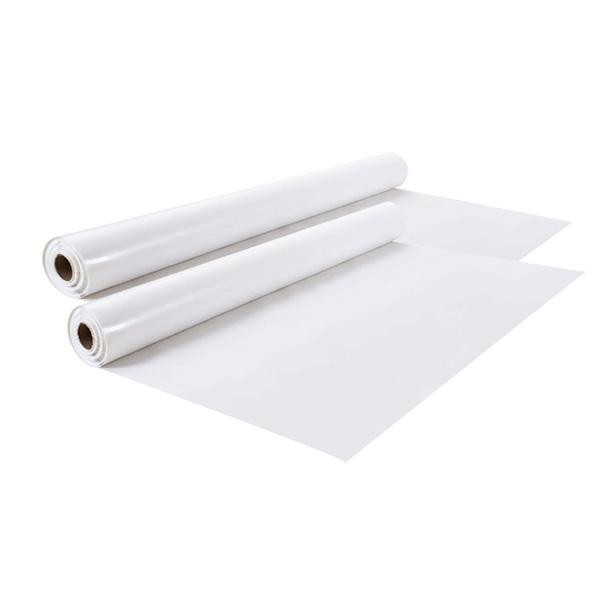
Single-ply membranes are large, factory-manufactured rolls of synthetic polymer. EPDM is a synthetic rubber known for its elasticity. TPO and PVC are thermoplastic membranes highly valued for their reflective properties and chemical resistance. These systems are rolled out over the deck and either fully adhered with bonding adhesives or mechanically fastened with heavy-duty anchors.
The main advantage of single-ply systems is their consistent, factory-controlled thickness, which eliminates the mil-thickness guesswork associated with liquid systems. TPO and PVC offer excellent UV resistance and long operational lifespans. However, seam welding requires highly specialized labor and expensive hot-air welding equipment. Mechanically fastening these systems into a dense deck is labor-intensive and creates thousands of penetration points. Furthermore, large sheet goods are less ideal for roofs densely packed with equipment footprints, as cutting and detailing around dozens of pipes compromises the efficiency of the sheet.
Membrane Category Comparison Matrix
| Category | Application Method | Primary Advantages | Primary Limitations |
|---|---|---|---|
| Liquid-Applied | Spray, Roller, Squeegee | Seamless, excellent detailing, fast turnaround | Requires strict thickness control, weather sensitive |
| Modified Bitumen | Torch-applied, Self-adhered | Exceptional thickness, high puncture resistance | Seam vulnerabilities, loses flexibility over time |
| Single-Ply (TPO/PVC) | Fully adhered, Mechanically fastened | Consistent factory thickness, high UV resistance | Complex seam welding, difficult around dense penetrations |
Selecting the optimal waterproofing system begins with a rigorous assessment of the existing deck. The Concrete Surface Profile (CSP) dictates how well a new membrane will adhere. Rough, heavily spalled concrete requires extensive resurfacing before applying thin liquid membranes, whereas thick bituminous sheets might tolerate minor surface imperfections. You must also evaluate the existing slopes to the drains. Flat decks with severe ponding water issues require systems specifically engineered for continuous submersion, such as specialized polyurethanes, rather than standard acrylics which will re-emulsify under standing water.
The density of penetrations heavily influences material selection. A wide-open, unobstructed deck is highly suitable for large rolls of single-ply synthetic membranes, allowing for rapid installation. Conversely, a deck crowded with HVAC units, ductwork, skylights, and plumbing vents makes sheet installation a detailing nightmare. In highly congested geometric spaces, liquid-applied membranes are far superior, as they easily mold to any shape without requiring complex cutting, patching, and pitch pocket construction.
Facility operations dictate the acceptable window for construction downtime. Occupied buildings, such as hospitals, data centers, or active manufacturing plants, cannot afford extended disruptions, strong odors, or the noise of heavy mechanical fastening. In these scenarios, decision-makers must weigh the trade-offs of different installation speeds and application methods.
Fast-curing liquid systems, particularly polyurea or PMMA (polymethyl methacrylate), are designed for rapid return-to-service. These materials can cure in hours, providing same-day waterproofing and minimizing facility disruption. However, these rapid systems often require highly specialized application equipment. Contrast this with fully adhered single-ply sheet systems, which take longer to stage, glue, and weld, but offer a quieter installation process without the strong solvent odors associated with some liquid coatings.
Installation Speed and Downtime Impact
| System Type | Cure / Usability Time | Odor / VOC Impact | Noise Disruption |
|---|---|---|---|
| PMMA / Polyurea | 1 to 4 hours | High (requires ventilation) | Low to Medium |
| Standard Polyurethane | 24 to 48 hours | Medium | Low |
| Mechanically Fastened TPO | Immediate upon fastening | Low | High (drilling into concrete) |
Evaluating waterproofing options requires looking past the initial contractor bid. Decision-makers need a framework for comparing upfront installation costs against the expected lifespan, maintenance frequency, warranty terms, and potential energy savings. A cheap, low-grade acrylic coating might offer the lowest initial capital expenditure, but if it requires complete reapplication every five years and offers zero insulation value, it becomes a financial liability.
Investing in a premium, reinforced elastomeric system demands a higher upfront cost but drastically maximizes structural Longevity. You must contrast the proactive cost of professional membrane installation against the exorbitant, disruptive costs of reactive structural repairs. Epoxy injection for deep cracks, extensive spall repair, and replacing water-logged insulation will quickly dwarf the cost of a high-quality waterproofing system. Factoring in the energy savings from a highly reflective cool roof further tips the scales toward premium systems.
The most common cause of waterproofing failure has nothing to do with the membrane material itself; it stems from inadequate surface preparation. Applying a membrane over laitance (a weak layer of cement dust on the surface), dirt, grease, or incompatible existing curing compounds guarantees poor adhesion. The membrane will eventually peel away from the deck, allowing water to travel laterally underneath the coating and enter the building far from the actual breach.
To mitigate this risk, project specifications must mandate aggressive mechanical preparation. Shot-blasting or diamond grinding are the industry standards for removing laitance and opening the pores to achieve a CSP of 3 or 4. Following mechanical prep, contractors must thoroughly vacuum the deck and apply system-specific primers to consolidate the surface and maximize the chemical bond between the deck and the membrane. Acid etching is never an acceptable preparation method for a roof deck.
Concrete acts as a massive moisture reservoir. Applying an impermeable waterproofing membrane over a damp deck traps that moisture inside the slab. When the sun heats the surface, the trapped moisture turns into vapor. This vapor drive creates immense upward pressure, causing the newly applied membrane to form massive blisters, delaminate, and eventually rupture, destroying the integrity of the installation.
Mitigating this risk requires strict environmental controls before application. Contractors must conduct standardized moisture testing, utilizing ASTM F2170 relative humidity probes drilled directly into the slab or calcium chloride tests. If the deck retains high moisture levels, the project requires the specification of moisture-tolerant epoxy primers or specialized vapor barriers that suppress vapor drive before the primary waterproofing layer is installed.
The vast majority of leaks do not occur in the center of the field; they occur at the edges, transitions, and penetrations. Premature leaks frequently develop at parapet walls, drain bowls, pitch pockets, and equipment curbs. These transition points experience the highest degree of differential movement and thermal stress, pulling the membrane away from the substrate.
To prevent these vulnerabilities, specifications must demand meticulous detailing. Mitigation strategies include installing cant strips at all 90-degree internal corners to ease the transition angle. Contractors must use reinforced flashing details, embedding polyester fabric into liquid resins around every single pipe and curb. Utilizing liquid-applied terminations ensures a seamless, watertight seal at the most critical junctions of the assembly, eliminating the reliance on temporary caulks and sealants.
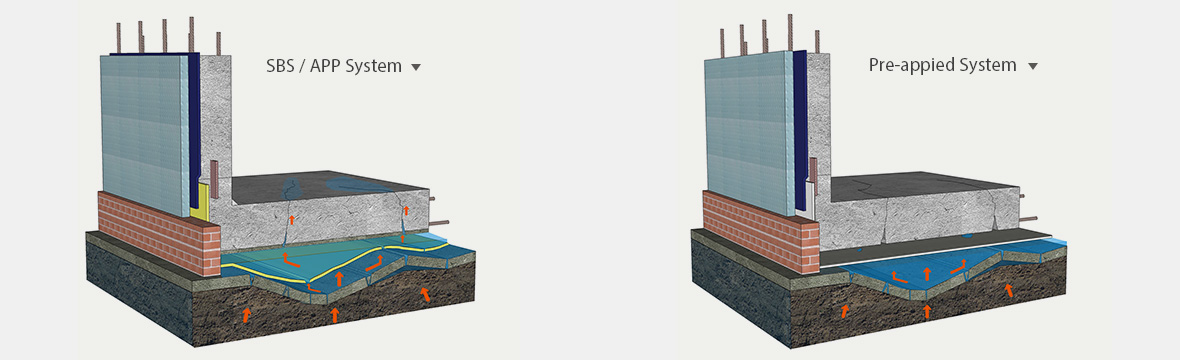
For building owners, contractors, and project teams seeking reliable waterproofing solutions, CANLON specializes in the development, manufacturing, and application support of high-performance polymer waterproofing and roofing materials. With advanced R&D and engineering expertise, seven manufacturing plants, and a portfolio covering pre-applied and post-applied membranes, roofing membranes, and waterproofing coatings, CANLON supports durable building-envelope protection across a wide range of construction applications.
Initiate a professional roof condition assessment to determine the current state of the deck and identify existing spalling or structural damage.
Conduct core testing and relative humidity probes to accurately measure the moisture content trapped within the slab and insulation layers.
Consult with certified membrane applicators and manufacturers to draft a site-specific specification that addresses your unique penetration density and operational downtime constraints.
Establish a routine, bi-annual inspection schedule to clear drains, check sealant joints, and maintain the integrity of the newly installed membrane.
A: The lifespan varies heavily by material type, climate, and maintenance. Liquid-applied acrylics may last 5 to 10 years, while high-quality polyurethanes, modified bitumen, and single-ply synthetic membranes typically last 15 to 30 years. Proper surface preparation and routine inspections significantly extend this operational lifetime.
A: There is no infinitely permanent waterproofing solution. All building materials eventually degrade due to UV exposure, thermal cycling, and environmental abrasion. However, selecting premium elastomeric membranes and adhering to strict maintenance schedules can push the replacement cycle out by several decades, maximizing your investment.
A: It depends on the chemical compatibility and adhesion of the existing coating. If the old coating is peeling or incompatible with the new solvents, it must be completely removed via grinding or shot-blasting. If it is sound and compatible, a specialized primer may allow for direct over-coating.
A: UV radiation breaks down the polymer chains in many materials, causing them to become brittle, lose their elastomeric crack-bridging properties, and eventually chalk or crack. High-quality membranes use UV-resistant aliphatic topcoats or reflective synthetic formulations to resist this degradation and maintain flexibility.
A: For heavy traffic, liquid-applied polyurethane or PMMA systems with an aggregate-infused wear course are ideal. Broadcasting silica sand or quartz into the wet topcoat creates a highly durable, slip-resistant surface that protects the underlying waterproofing layer from dropped tools and heavy boots.
A: Membranes create an impermeable barrier that stops water and dissolved oxygen from penetrating the capillary pores. By keeping the matrix dry, the protective alkaline environment around the rebar is preserved. This prevents the steel from oxidizing, expanding, and fracturing the surrounding concrete.
A: Yes. Liquid-applied membranes are generally superior for highly congested roofs. Because they are applied as a fluid, they seamlessly conform to complex shapes, HVAC curbs, and tight pipe clusters. Sheet membranes require extensive cutting, patching, and seam welding around penetrations, increasing the risk of installation errors.