
Views: 0 Author: Site Editor Publish Time: 2026-07-29 Origin: Site


Water ingress in concrete structures introduces massive structural liabilities. Rebar corrosion and concrete spalling compromise load-bearing capacity rapidly. Concrete is inherently porous, and micro-cracking occurs naturally as the material cures and settles over time. Failing to specify the correct waterproofing system at the design or remediation stage leads to catastrophic structural degradation. Repair efforts become highly resource-intensive and disruptive to building occupants. Industry codes and testing standards dictate structural waterproofing compliance. Frameworks like ACI 351/515, BS 8102, and various ASTM standards establish strict performance baselines for these materials. Selecting the right system requires a rigorous evaluation of site conditions. You must assess hydrostatic pressure, environmental exposure, and installation constraints before specifying a solution. We see foundation walls fail within five years simply because the design team ignored seasonal water table fluctuations. You cannot cut corners during the specification phase.
Application Dictates Material: Membrane selection must be driven by structural placement (above-grade vs. below-grade) and water pressure dynamics (positive vs. negative side).
Seamless vs. Uniform Thickness: Liquid-applied membranes eliminate seam vulnerabilities but require strict environmental controls, whereas sheet membranes guarantee uniform thickness but introduce risk at joints.
Implementation Outweighs Product: Even premium membranes fail without rigorous substrate preparation, proper detailing at penetrations, and post-installation quality assurance testing.
Companion Systems Are Mandatory: High-performance waterproof membranes for structures must be paired with adequate drainage composites and protection boards to survive backfilling and service lifespans.

A membrane must withstand continuous or intermittent hydrostatic head pressure without delamination or blistering. Testing parameters like ASTM D5385 verify this resistance by subjecting the membrane to increasing water pressure over a set duration. Below-grade concrete structures also require protection against capillary draw. Groundwater naturally wicks upward through porous concrete via capillary action, pulling moisture into interior spaces. Effective Waterproof Membranes for Structures block this moisture migration entirely. When evaluating a site, you must determine the maximum historical water table elevation. Designing for the average water table guarantees failure during a hundred-year flood event. The membrane must handle the peak hydrostatic load.
Field testing for hydrostatic resistance often involves mock-ups and localized pressure tests. We look for any signs of water bypassing the membrane at the transition zones. If the material cannot hold back the water pressure, it will eventually balloon and rupture. You need a system that maintains its bond to the substrate even when pushed to its physical limits by groundwater.
Elastomeric properties dictate structural longevity. The membrane must accommodate thermal expansion, contraction, and structural settling. It must stretch without rupturing when the underlying concrete moves. Baseline elongation and tensile strength requirements ensure durability. Standards like ASTM C1305 and ASTM C836 define these dynamic structural environments. Rigid systems fail when concrete inevitably cracks under load or temperature changes.
To verify crack bridging capabilities, manufacturers subject materials to repeated stretching cycles at low temperatures. A high-quality membrane will span a 1/16-inch crack without tearing. When applying these systems in the field, we often install a detail coat or reinforcing fabric over known static cracks before applying the main membrane layer. This provides extra elongation capacity exactly where the structure needs it most.
Lateral water migration occurs when water travels between the membrane and the concrete substrate. This happens if a breach occurs in the system from a puncture or poor detailing. Continuous, fully bonded adhesion isolates these breaches. ASTM D903 testing measures this peel adhesion strength. A fully bonded system prevents water from tracking across the structure, making leak detection and localized repair possible.
If a loosely laid membrane gets punctured, water can travel fifty feet under the sheet before showing up inside the building. You will never find the original leak source without tearing up the entire foundation. Fully bonded systems confine the water to the exact location of the puncture. We test adhesion in the field using pull-off tests to ensure the primer and membrane have achieved a destructive bond with the concrete.
Below-grade applications face aggressive environmental factors. Membranes need resistance to soil alkalinity, chlorides, sulfates, and potential groundwater contaminants. Green roofs and planter applications require specialized root barriers. FLL guidelines dictate root resistance standards. Without these protections, organic growth and chemical degradation will destroy the waterproofing layer in a matter of months.
Roots are incredibly aggressive. They will find microscopic pinholes in a membrane and force their way through, expanding as they grow and shattering the waterproofing seal. We specify membranes with physical root barriers or chemical root inhibitors for any vegetated assembly. Additionally, industrial sites often have contaminated soil. You must test the groundwater chemistry and verify that the selected membrane will not degrade when exposed to local hydrocarbons or high-alkali soils.
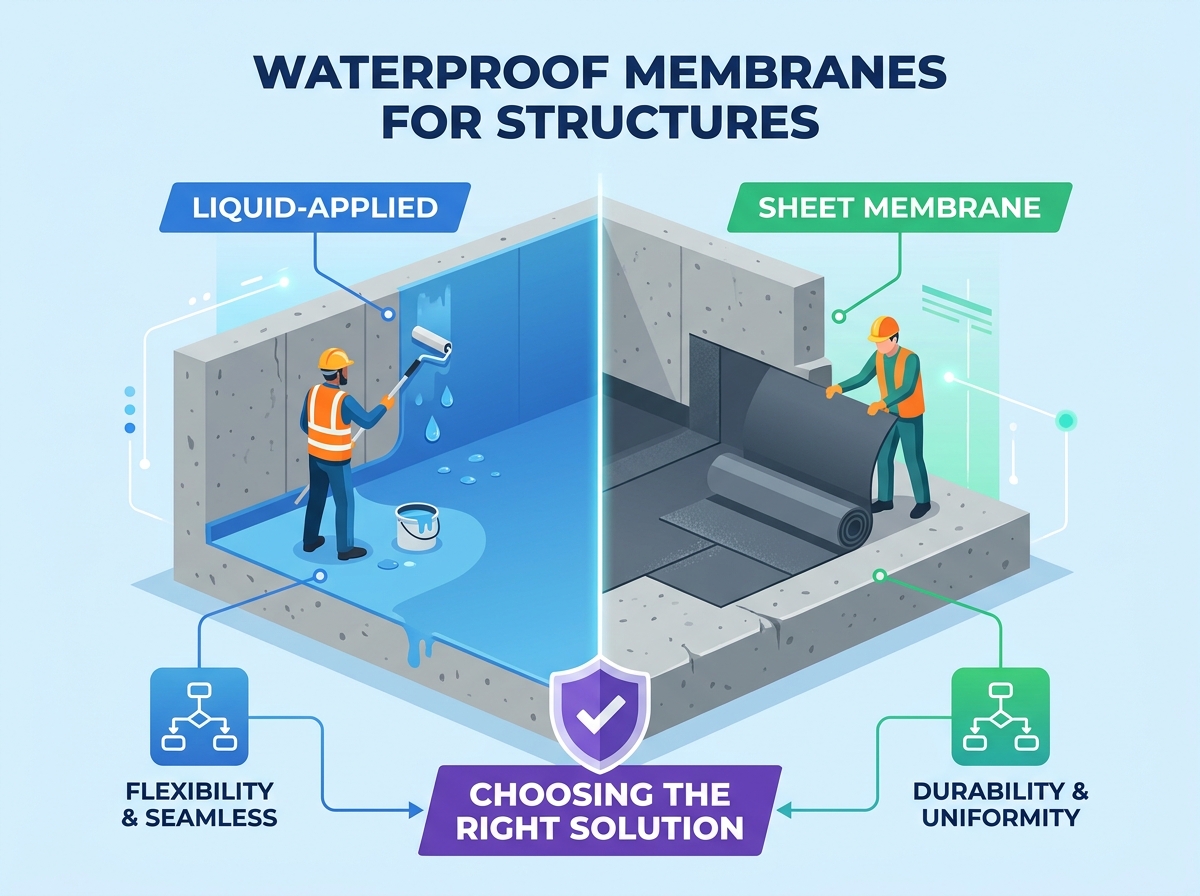
These are factory-manufactured rolls. Applicators install them via self-adhesion, torch-applied, or mechanically fastened methods. They provide a guaranteed mil thickness across the entire surface. Sites are immediately ready for backfilling or subsequent construction phases. They offer high puncture resistance. However, they introduce vulnerabilities at seams, laps, and complex geometric detailing like pipe penetrations.
When installing sheet membranes, the crew must execute perfect lap joints. A single fish-mouth at a seam compromises the entire wall. We use heavy steel rollers to press the seams together and ensure full adhesive contact. For torch-applied systems, the applicator must achieve the correct bleed-out of bitumen at the edge of the roll. Too little heat results in a cold joint; too much heat destroys the reinforcement matrix inside the sheet.
Prime the concrete substrate and allow it to flash off completely.
Align the first sheet and remove the release liner while applying firm pressure.
Overlap subsequent sheets by a minimum of two to four inches, depending on manufacturer specs.
Roll all seams with a weighted steel roller to eliminate trapped air.
Apply liquid mastic to all termination edges and T-joints.
Liquid systems utilize cold-applied or hot-spray liquids. They cure into a monolithic, elastomeric coating. This provides a completely seamless application. They offer superior detailing capabilities on complex structural geometries. High flexibility is a major advantage. Conversely, they are highly dependent on substrate moisture limits. Ambient temperature and applicator skill heavily influence the final dry film thickness.
You must measure the wet film thickness continuously during application. We use a simple notched gauge to check the depth of the liquid before it cures. If the specification calls for 60 mils, the applicator must hit that number consistently. Thin spots will fail prematurely. Polyurea systems cure in seconds, requiring expensive plural-component spray rigs and highly trained operators. PMMA systems cure rapidly even in freezing temperatures, making them excellent for winter construction schedules.
These systems feature natural sodium bentonite clay. The clay is needle-punched between geotextile layers. It swells upon contact with moisture to form an impermeable barrier. They offer self-healing capabilities for minor punctures. They are ideal for blind-side applications and require minimal substrate preparation. However, they are susceptible to premature hydration from rain before concrete placement. They also require constant, uniform confinement to function.
If bentonite gets wet before the concrete is poured, it swells and loses its waterproofing capacity. We cover these installations with heavy tarps if rain is in the forecast. Once the concrete is poured, the weight of the structure confines the clay. When groundwater hits the bentonite, it tries to swell but cannot expand due to the confinement. This creates a dense, watertight paste that seals against the concrete face.
These are brush-applied coatings or chemical admixtures. They react with unhydrated cement particles and moisture. This reaction grows insoluble crystals within concrete capillaries and micro-cracks. They are excellent for negative-side water pressure. They integrate directly into the concrete matrix and cannot be punctured. They are non-toxic and ideal for potable water structures. Their rigid composition lacks the elastomeric properties required to bridge moving cracks.
We use crystalline waterproofing primarily in elevator pits and water treatment tanks. You can apply it to the inside of a leaking basement wall, and the crystals will grow deep into the concrete, chasing the water source. It is one of the few systems that works effectively against negative hydrostatic pressure. However, if the concrete develops a structural crack wider than 0.4mm, the crystals cannot bridge the gap, and the crack will leak.
| Membrane Type | Primary Advantage | Primary Limitation | Best Application |
|---|---|---|---|
| Pre-Formed Sheet | Guaranteed uniform thickness | Vulnerable seams and joints | Large, flat below-grade walls |
| Liquid-Applied | Seamless, monolithic finish | Weather and skill dependent | Complex geometries, plaza decks |
| Bentonite Clay | Self-healing properties | Requires strict confinement | Blind-side zero-lot-line walls |
| Crystalline | Integrates into concrete matrix | Lacks dynamic crack bridging | Negative-side elevator pits |
Above-grade applications demand specific performance traits. Focus on UV stability, breathability, and resistance to extreme thermal cycling. Freeze-thaw damage is a primary concern for exposed concrete. Below-grade applications face different threats. Focus on hydrostatic pressure resistance, root barrier capabilities, and resistance to aggressive soil chemicals. The environment dictates the material chemistry.
You cannot use a below-grade membrane on an exposed balcony. The sun's ultraviolet rays will degrade the material within months, turning it brittle and causing it to flake away. Conversely, above-grade breathable coatings will fail instantly if buried underground and subjected to standing water. You must match the physical properties of the Waterproof Membranes for Structures to the exact environmental exposure they will face.
Application orientation determines system viability. Positive-side waterproofing applies to the water-facing exterior. Negative-side applies to the dry interior side, often used for remediation. Blind-side or pre-applied systems are installed before concrete placement. These are necessary for zero-lot-line foundations where exterior access is impossible after pouring.
Blind-side waterproofing requires a mechanical bond to the poured concrete. We install the membrane against the soil retention system, and then the structural concrete is poured directly against the membrane. As the concrete cures, it locks into a specialized layer on the membrane, creating a permanent seal. If you use the wrong material here, the concrete will not bond, and water will easily track between the wall and the waterproofing layer.
Assess membrane durability against post-installation conditions. Systems subjected to green roofs require root barriers. Vehicular traffic on parking decks or split-slab plazas demands high compressive strength. Heavy backfill materials require robust puncture resistance. The membrane must withstand the specific overburden it will support throughout its service life.
When designing a plaza deck, the waterproofing layer sits beneath concrete topping slabs, pavers, or landscaping. If the membrane fails, you have to remove all that heavy overburden to fix the leak. We specify heavy-duty, reinforced liquid systems or thick rubberized asphalt for these assemblies. The material must handle the compressive load of vehicles and the abrasive forces of shifting sand beds without wearing thin.
A waterproof membrane cannot function in isolation. Geocomposite drainage boards relieve hydrostatic head pressure against the structure. They channel water away to perimeter drains. Protection courses prevent damage from post-construction backfill operations. Without these companion systems, even the most robust membrane will suffer puncture damage or overwhelming water pressure.
We never backfill directly against a bare membrane. Sharp rocks and construction debris in the soil will puncture the material as the dirt settles. A dimpled drainage board serves two purposes: it acts as a physical shield against the backfill, and it creates a void space for water to drop down to the weeping tile. Managing the water before it even reaches the membrane is the most effective waterproofing strategy.
Local Volatile Organic Compound regulations affect material selection. These rules dictate the choice between solvent-based and water-based systems. High-solids systems often meet strict environmental codes. Additionally, specific membranes contribute to LEED points. Consider recycled content, regional materials, and low-emitting materials when specifying sustainable construction projects.
In dense urban environments, you cannot use high-VOC solvent-based primers. The fumes will enter adjacent buildings through HVAC intakes, causing immediate complaints and potential job site shutdowns. We rely on 100% solids polyurethane or water-based epoxies in these scenarios. They provide excellent adhesion without the hazardous off-gassing, keeping the project compliant with local air quality districts.
Evaluate the relationship between material selection and labor hours. Premium materials like PMMA or Polyurea require specialized equipment. However, their rapid curing times drastically reduce labor hours. Multi-ply bituminous systems utilize standard materials but demand extensive, slow labor. Speed of installation often offsets initial resource allocation. Project timelines dictate which approach provides better overall value.
If a project is behind schedule, spending more on a fast-curing liquid membrane makes sense. A crew can spray ten thousand square feet of polyurea in a single day and backfill the next morning. A hot-applied rubberized asphalt system might take a week to install over the same area due to the melting process and multi-layer application. You have to weigh the hourly cost of the crew against the per-gallon cost of the resin.
Manufacturer warranties vary significantly. Differentiate between material-only warranties and comprehensive system warranties. Single-source warranties cover labor, detailing accessories, and overburden removal. A robust warranty reflects the manufacturer's confidence in the system's lifespan. Regular maintenance inspections extend this lifespan, ensuring the structure remains protected against evolving environmental stresses.
A material-only warranty is practically useless for below-grade applications. If a membrane fails, the cost of the replacement liquid or sheet is negligible. The real expense lies in excavating twenty feet of dirt, shoring the trench, and cleaning the wall. We demand single-source warranties that cover the removal and replacement of overburden. Manufacturers will only issue these warranties if their certified inspectors approve the installation at every phase.
System failure introduces massive structural and operational risks. Below-grade remediation requires extensive excavation. It causes severe tenant disruption and necessitates complex structural repair. Selecting inadequate upfront solutions poses a massive risk to the building's integrity. Proper specification prevents these catastrophic failures and preserves the structure's intended service life.
When water breaches a foundation, it rusts the reinforcing steel. The steel expands as it rusts, spalling the concrete and destroying the structural capacity of the wall. Fixing this requires chipping out the damaged concrete, treating the rebar, patching the wall, and injecting chemical grouts from the interior. The labor and disruption involved in this remediation far exceed the cost of doing the waterproofing correctly the first time.
Concrete requires a standard 28-day curing period. Surface profiling must meet ICRI Concrete Surface Profile standards to ensure mechanical bond. Moisture testing is non-negotiable. Use ASTM F1869 calcium chloride tests or ASTM F2170 relative humidity probes. Excess moisture causes membrane outgassing and delamination. Rigorous preparation mitigates these failure points.
We reject concrete surfaces that have form release agents, curing compounds, or laitance still attached. These contaminants act as bond breakers. The crew must shotblast or grind the concrete to achieve a CSP 3 or 4 profile, which looks like medium-grit sandpaper. This opens the pores of the concrete, allowing the primer to penetrate and lock into the substrate. Skipping this step guarantees the membrane will peel off.
Conduct a visual inspection for cracks, spalls, and honeycombing.
Mechanically profile the surface using grinders or shotblasters.
Perform moisture testing using in-situ RH probes.
Patch all voids and bug holes with a compatible repair mortar.
Apply the manufacturer-specified primer at the correct coverage rate.
Ambient and substrate temperatures dictate application windows. Dew point and relative humidity impact curing kinetics. They affect adhesion and film formation in liquid systems. Applying materials outside specified thermal windows leads to incomplete curing or poor bonding. Environmental monitoring throughout the installation process is mandatory for success.
You must track the dew point constantly. If the substrate temperature falls within five degrees of the dew point, condensation will form on the concrete. You cannot see this micro-layer of moisture, but if you apply a polyurethane membrane over it, the material will react with the water, foam up, and fail to bond. We use infrared thermometers and digital hygrometers to verify conditions before opening a single bucket of material.
Complex geometries represent the primary points of failure. They account for the vast majority of structural leaks. Proper detailing requires specific accessories. Use cant strips, reinforcing fabrics, and liquid detailing mastics. Termination bars and counter-flashing secure the membrane edges. Strict adherence to manufacturer detailing guidelines prevents water ingress at these vulnerable transitions.
A pipe penetrating a foundation wall moves independently of the concrete. You cannot simply run a sheet membrane up to the pipe and cut a hole. We install a liquid flashing around the pipe, embed a reinforcing fleece into the liquid, and tie that assembly back into the main field membrane. This creates a flexible, watertight collar that can handle the differential movement without tearing.
Selecting the appropriate waterproof membrane is fundamental to protecting concrete structures from long-term water damage, preserving structural integrity, and reducing lifecycle maintenance costs. By carefully evaluating hydrostatic pressure, environmental exposure, installation conditions, and project requirements, building professionals can specify waterproofing systems that deliver reliable performance, long-term durability, and sustainable value.
To maximize waterproofing performance, consider the following recommendations:
Evaluate site conditions, groundwater pressure, and structural requirements before selecting any waterproof membrane.
Match membrane systems with the intended application, including above-grade, below-grade, positive-side, or blind-side waterproofing.
Ensure proper substrate preparation, moisture testing, and detailing at joints, penetrations, and transition areas.
Select complete waterproofing systems that include drainage boards, protection layers, and manufacturer-backed warranties for long-term reliability.
With decades of experience in advanced waterproofing technology and building envelope innovation, CANLON has become a globally trusted manufacturer of high-performance waterproofing membranes and integrated construction solutions. Through continuous investment in research and development, intelligent manufacturing, and rigorous international quality management, the company provides reliable waterproofing systems that are widely applied in commercial buildings, infrastructure, industrial facilities, and residential developments around the world.
From structural waterproof membranes and roofing waterproofing systems to comprehensive building envelope solutions, CANLON offers a complete portfolio of innovative products, professional engineering support, customized project solutions, and long-term technical services. By combining sustainable technologies with customer-focused innovation, CANLON helps architects, engineers, contractors, and developers improve construction quality, extend building lifespan, and deliver durable, energy-efficient, and resilient structures.
A: Positive-side waterproofing is applied to the exterior surface directly exposed to water. It prevents moisture from entering the substrate. Negative-side waterproofing is applied to the interior, dry side of the structure. It stops water that has already penetrated the concrete from entering the interior space.
A: Excess moisture trapped in concrete causes outgassing as temperatures rise. This vapor pressure creates blisters and pinholes in liquid-applied membranes. Testing ensures the concrete is dry enough to allow proper adhesion and a monolithic, defect-free cure.
A: While possible, it is highly challenging. Sheet membranes require cutting, folding, and overlapping at corners and penetrations. These seams introduce multiple failure points. Liquid-applied membranes are generally preferred for complex geometries because they form a seamless layer.
A: A drainage board provides a pathway for water to flow down to the perimeter drain. This relieves hydrostatic pressure against the waterproof membrane. It also acts as a physical protection layer during backfilling operations.
A: A properly specified and installed system can last the lifetime of the structure. However, lifespan depends heavily on material quality, correct installation, companion drainage systems, and environmental exposure. Most premium systems offer warranties ranging from 10 to 25 years.